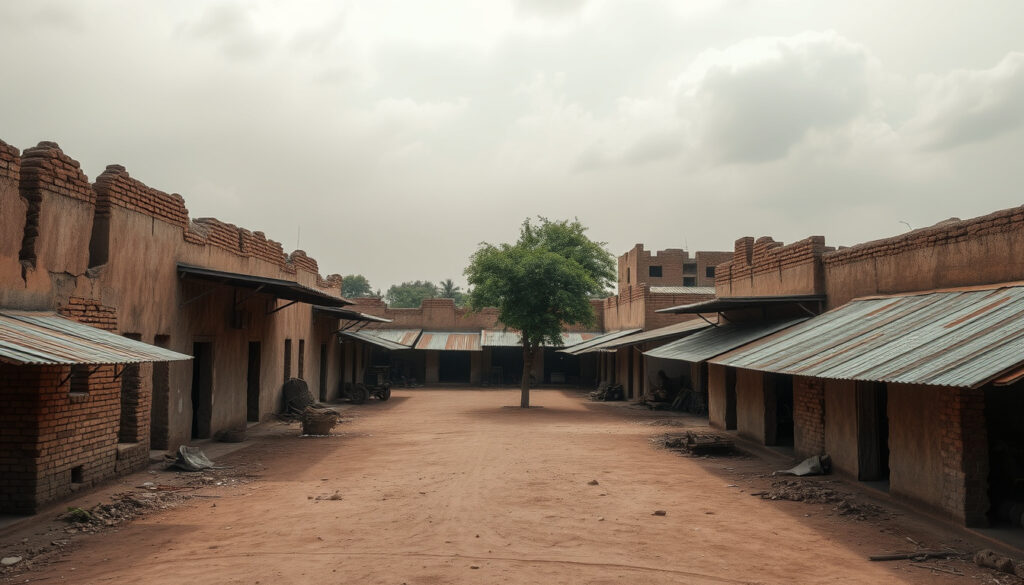
Poorest Country in the World 2025: Ranking and Facts
There’s a question that comes up every time global rankings are published: which country sits at the very bottom of the economic ladder? The answer, consistent across most major datasets, is South Sudan — a nation where decades of conflict and climate shocks have kept GDP per capita below $500.
Poorest country (GDP per capita): South Sudan (~$455) · Top 10 poorest region: All in Africa · Richest country: Luxembourg ($155,941) · Global wealth owned by richest 1%: Nearly 50%
Quick snapshot
- South Sudan ranks as world’s poorest by GDP per capita (Global Finance Magazine, financial data publisher)
- Top 10 poorest countries are all in Africa (Global Finance Magazine, financial data publisher)
- Exact GDP figures vary by source (PPP vs nominal) (World Bank, international development institution)
- Rankings can shift with new conflict or economic revisions (IMF, global economic authority)
- Since 2020, conflict-affected economies shrank 1.8% per year (World Bank, international development institution)
- Poorest 32 low-income countries grew only 3.3% (2022‑2024) (IMF, global economic authority)
- 2025–2026 rankings updated by IMF and Global Finance Magazine (World Bank, international development institution)
- World Bank tracks fragility-driven poverty (421 million people under $3/day) (World Bank, international development institution)
Eight countries, one pattern: every entry on the poorest list faces protracted conflict, weak institutions, or climate vulnerability — or all three.
| Label | Value |
|---|---|
| Poorest country | South Sudan (2025) |
| GDP per capita (poorest) | $455 (approx.) |
| Second poorest | Burundi (~$800) |
| Number of poorest in Africa | 10 out of 10 |
| Richest country | Luxembourg ($155,941) |
The implication: the concentration of extreme poverty in a single continent reflects systemic factors that go beyond income — conflict and weak governance reinforce one another.
What is the Poorest Country in the World?
In 2025, Global Finance Magazine’s ranking using GDP-PPP per capita places South Sudan at the very bottom, with a value of 716.249 current international dollars (Global Finance Magazine, financial data publisher). When translated to nominal GDP per capita — simpler dollar values — the figure is around $455, a number that has barely budged in years.
Why South Sudan ranks last
- Civil war and intercommunal violence have displaced millions and destroyed infrastructure.
- Oil dependence makes the economy vulnerable to price swings and pipeline blockages.
- Recurrent floods and droughts erode what little agricultural output remains.
The World Bank notes that in economies affected by conflict or instability, average GDP per capita is now about $1,500 a year — and since 2020 these economies have been shrinking by 1.8% annually (World Bank, international development institution). Meanwhile, other developing economies have grown 2.9% per year over the same period.
South Sudan is not just poor on paper; conflict directly destroys livelihoods faster than aid or oil revenue can rebuild them. For the 421 million people living on less than $3 a day in fragile states, the gap between survival and stability keeps widening.
What this means: The “poorest country” label is not a static statistic — it’s a measure of how profoundly war and weak governance can trap an entire nation. Without a sustained peace deal, South Sudan will likely remain at the bottom for years.
What are the Top 10 Poorest Countries?
The ten poorest economies, all located in Africa, form a list where GDP-PPP per capita ranges from $716 to just over $2,000. Here they are, according to Global Finance Magazine’s 2025 data:
- South Sudan – $716.25
- Burundi – $1,015.17 (Global Finance Magazine, financial data publisher)
- Central African Republic – $1,329.96
- Yemen – $1,674.74
- Mozambique – $1,728.85
- Malawi – $1,777.95
- Democratic Republic of the Congo – $1,884.15
- Somalia – $1,915.71
- Liberia – $2,005.76
- Madagascar – $2,043.02
The IMF reports that the poorest 32 countries eligible for concessional lending grew only 3.3% from 2022 to 2024, compared with 5.3% for the more advanced low‑income group (IMF, global economic authority).
One pattern: all ten are scarred by either recent conflict (Yemen, Somalia, CAR) or governance failures that prevent basic services from reaching citizens.
What is the Second Poorest Country in the World?
Burundi consistently ranks second on the list of poorest countries, with a PPP‑adjusted GDP per capita of $1,015.17 (Global Finance Magazine, financial data publisher). Its economy, like South Sudan’s, is hammered by political instability and a lack of infrastructure. The difference: Burundi has not experienced full‑scale civil war in the past decade, yet its growth remains sluggish due to corruption and land pressure.
What this means: Being second poorest is not a consolation. It shows that peaceful but badly governed countries can also sink to the bottom. The trigger is not only war — weak institutions and aid dependency are equally potent traps.
Ten countries, one pattern: placing the poorest nations side by side with the richest underscores how dramatically economic output diverges across the planet.
| Metric | Poorest (South Sudan) | Richest (Luxembourg) |
|---|---|---|
| GDP per capita (PPP) | ~$716 | ~$155,941 |
| GDP per capita (nominal) | ~$455 | ~$155,941 |
| Population | ~11 million | ~0.67 million |
| Primary economic sector | Oil (declining) | Finance & services |
| Fragile States Index rank | 2nd most fragile (2025) | Lowest fragility |
The trade-off: Luxembourg’s wealth is built on a stable, service‑based economy; South Sudan’s poverty is a product of instability and resource curse. The gap is not just about natural resources but about the rule of law and peace.
Which is the Richest Country in the World?
Luxembourg leads the world with a GDP per capita of $155,941 (nominal), as reported by Global Finance Magazine. The country’s wealth is built on a robust financial services sector, high productivity, and a small population.
What this means: The poorest country in the world earns in a year what a Luxembourg resident earns in roughly two and a half days. That ratio — 350:1 — shows how extreme economic inequality has become between the richest and poorest nations.
Global wealth concentration is staggering: the richest 1% own nearly half of the world’s wealth, while the poorest 50% own less than 1% (Concern.net, humanitarian NGO). That structural inequality is both a cause and a consequence of the poverty trap.
How is Poverty Measured for Countries?
Three main frameworks are used to classify and rank poverty among nations:
| Metric | What it measures | Limitations |
|---|---|---|
| GDP per capita (PPP) | Value of goods & services adjusted for local prices | Does not reflect inequality within country |
| Fragile States Index | Political, social, and economic pressures | Combines many factors; not purely economic |
| UN Least Developed Countries (LDC) list | Income, human assets, economic vulnerability | Updated every three years; slow to change |
The World Bank’s latest data point: 421 million people live on less than $3 a day in conflict‑affected economies (World Bank, international development institution). That is more than the entire population of the United States.
The catch: No single metric tells the full story. A country can have a low GDP per capita but still provide basic services (e.g., Malawi), while another may be fragile yet slightly richer (e.g., Yemen). That’s why analysts use both income and fragility measures.
Who Owns 50% of the World’s Wealth?
According to Oxfam and Credit Suisse data cited by Concern.net, the richest 1% of the global population controls nearly half of all household wealth. In contrast, the bottom 50% — about 4 billion people — own less than 1%.
What this means: Wealth inequality on a planetary scale means that progress in the poorest countries barely moves the global share. Even if South Sudan’s economy doubled, it would represent a tiny fraction of the wealth held by a single billionaire.
What is the Weakest Country in the World?
The Fragile States Index, produced by the Fund for Peace, consistently places Somalia at the top of the most fragile list. The index combines 12 indicators including security, state legitimacy, and human rights.
- Somalia shares many poverty drivers with South Sudan: long‑running conflict, weak government, and climate‑related shocks.
- But fragility and poverty are not identical: some fragile states (e.g., Syria) have higher GDP per capita than the poorest countries.
Why this matters: When you search for the “weakest” country, you get a different answer than the “poorest” — though the overlap is large. Understanding both concepts helps policymakers target different forms of aid.
Timeline: How the Poorest Country List Has Evolved
- – South Sudan gains independence, becomes one of the world’s poorest nations.
- – – Civil conflict and catastrophic flooding deepen poverty in South Sudan; GDP per capita falls further.
- – World Bank updates GDP per capita data, confirming South Sudan at the bottom (World Bank, international development institution).
- – Global Finance Magazine publishes its 2025 poorest‑countries list; IMF warns of widening gap between fragile and non‑fragile economies (IMF, global economic authority).
Clarity: What We Know vs. What We Don’t
Confirmed facts
- South Sudan ranks poorest by PPP GDP per capita in 2025 (Global Finance Magazine, financial data publisher)
- Top 10 poorest are all in Africa (Global Finance Magazine, financial data publisher)
- 421 million people in conflict zones live under $3/day (World Bank, international development institution)
- IMF: poorest 32 countries grew just 3.3% (2022‑2024) (IMF, global economic authority)
What remains unclear
- Exact positioning depends on PPP vs nominal measurement
- Rankings can change if a country’s data is revised or conflict erupts
- Fragile States Index and GDP rankings don’t always align perfectly
Expert Perspectives
“Economies facing conflict or instability have GDP-per-capita levels of about $1,500 a year — and they’ve been shrinking by 1.8% annually since 2020, while other developing economies have grown.”
— World Bank, international development institution
“Among low-income countries eligible for concessional lending, the poorest 32 grew only 3.3% from 2022 to 2024, compared to 5.3% for the more advanced group.”
— IMF, global economic authority
For a country at the bottom of the list, the path out is not simply about receiving more aid — it requires ending conflict, building institutions, and diversifying the economy. For the wealthiest nations, the gap between $455 and $155,941 is a measure of global inequality that demands both moral and practical responses.
Related reading: poorest country in the world 2025 GDP per capita · IMF poorest countries fragile states falling behind
nu.cw, apnews.com, worldpopulationreview.com, imf.org, oecd.org, imf.org, reddit.com, imf.org, worldbank.org
According to the latest IMF data, the poorest country ranking 2025 confirms South Sudan as the world’s poorest nation.
Frequently asked questions
Is South Sudan the poorest country in the world?
Yes, by GDP per capita (both PPP and nominal), South Sudan ranks as the world’s poorest country in 2025 (Global Finance Magazine, financial data publisher).
How is GDP per capita calculated?
It divides a country’s gross domestic product by its population. PPP adjustments account for price differences across countries.
Why are most poorest countries in Africa?
A combination of colonial legacies, conflict, weak governance, and climate‑related shocks has trapped many African economies in low‑income cycles (Concern.net, humanitarian NGO).
Does the Fragile States Index align with poverty rankings?
Largely, yes — but not perfectly. Somalia is the most fragile state but ranks eighth poorest by GDP per capita. Fragility incorporates security and political factors beyond income.
What is the poorest country in Asia?
Afghanistan is often cited as Asia’s poorest, with a GDP per capita around $500–$600, though data is sparse.
How many least developed countries are there?
The UN currently lists 46 Least Developed Countries (LDCs), most of which are in Africa (United Nations, global body).
Can a country move out of the poorest list?
Yes, but it requires sustained growth, political stability, and investment. For example, Rwanda has seen strong growth over the past two decades, moving out of the bottom ranks.
What is the difference between poorest and weakest country?
“Poorest” refers to income; “weakest” (or most fragile) refers to state capacity. The two lists overlap but are not identical.
More related posts
 Back to School Allowance 2026: Rates, Eligibility & How to Apply
 My Computer Won’t Turn On: Step-by-Step Troubleshooting Guide
 What Should Your Heart Rate Be – Normal Ranges by Age
 F&F Clothing Online – Tesco Guide to Deals, Sizes and Quality
 174 cm in Feet: Exact Conversion & Height Guide (5’8″ or 5’9″?)
 Peter Jones Net Worth: Dragons’ Den Richest £1.2B
 Redken Acidic Bonding Concentrate: How It Compares to Olaplex
 Skip Hire Near Me Ireland: Real Costs & Banned Items Guide