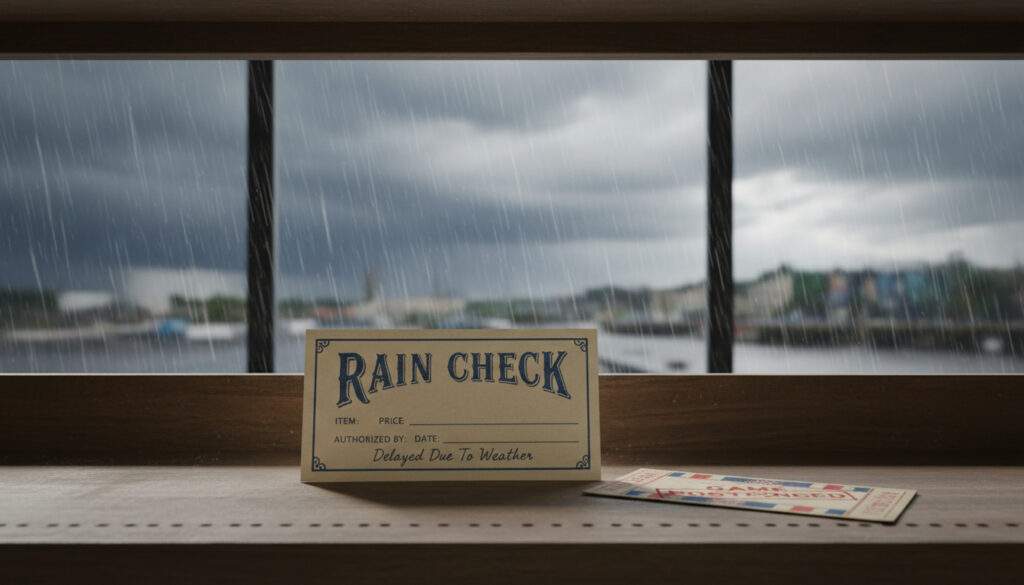
What Is a Rain Check – Meaning, Origin, Retail Policies
A rain check represents both a physical voucher and a social promise. In retail contexts, it guarantees a sale price when items sell out. In conversation, it defers an invitation without refusal. The phrase carries distinct weight across commerce and culture, rooted in 19th-century American baseball traditions.
The dual functionality creates occasional confusion. Shoppers encounter rain checks when advertised specials vanish from shelves. Friends exchange them when scheduling conflicts arise. Despite digital alternatives, the concept persists in grocery chains and big-box stores, though specific policies vary significantly by retailer and location.
Understanding the mechanism requires examining its evolution from sports stadiums to supermarket customer service desks. The journey reveals how commercial goodwill transforms into standard practice.
What Is a Rain Check?
A voucher or promise to honor a deferred offer, whether a sale price or social engagement.
1880s baseball admission tickets for rained-out games.
Guarantees advertised prices on out-of-stock merchandise.
Polite postponement of invitations or favors.
- The term first appeared in print around 1884, specifically referencing baseball tickets issued when rain canceled games.
- By the late 1800s, the phrase had migrated from sports stadiums to retail environments and social conversation.
- Modern rain checks typically exclude clearance items and limited-quantity doorbusters.
- Major League Baseball continues using the concept today, with original tickets serving as rain checks for suspended games.
- Retail policies generally require redemption within 30 to 90 days, though timeframes vary by chain.
- The 1975 Zabar’s Cuisinart incident remains a notable example of retail rain check history, when a discounted food processor sold out instantly.
- Digital notification systems increasingly replace physical vouchers, though paper rain checks persist in grocery sectors.
| Attribute | Details |
|---|---|
| First Recorded Use | 1884 (baseball context) |
| Earliest Practice | 1870 (St. Louis Brown Stockings) |
| Primary Modern Contexts | Retail, Social |
| Legal Status | Goodwill gesture, not binding contract |
| MLB Current Rule | Original ticket serves as rain check for games suspended before five innings |
| Retail Application | Out-of-stock sale items |
| Common Issuers | Grocery stores, big-box retailers |
| Typical Validity | 30-90 days (varies by retailer) |
| Notable Example | 1975 Zabar’s Cuisinart incident ($135 price honored) |
| Modern Trend | Digital app notifications replacing paper vouchers |
How Do Rain Checks Work in Retail?
Retail rain checks function as price-protection mechanisms. When a store advertises a specific item at a reduced rate but exhausts inventory before the sale ends, management issues a voucher allowing purchase at the advertised price upon restocking. This practice maintains customer goodwill while managing inventory volatility.
The process typically requires visiting customer service desks. Shoppers present the advertised special, either through physical flyers or digital confirmations, and request documentation for the unavailable item. Staff verify the promotion’s validity and stock status before generating the rain check certificate.
Store-Specific Variations
Policies diverge significantly across retail categories. Grocery stores frequently offer rain checks for perishable sale items, recognizing that supply chains fluctuate weekly. Big-box retailers maintain similar programs for electronics and household goods, though corporate policies vary by location and item category.
Exclusions remain standard across the industry. Clearance merchandise, limited-quantity doorbusters, and Tesco F&F clothing deals typically fall outside rain check eligibility. Retailers limit exposure to loss leaders while maintaining promotional integrity for regular stock rotations.
Rain checks typically exclude clearance items, limited-quantity doorbusters, and special holiday promotions. Alcohol and tobacco products often face additional restrictions based on state regulations.
Requesting a Rain Check
Successful acquisition requires timing and documentation. Customers must request rain checks during the advertised sale period, not weeks afterward. Required materials include proof of the promotion and identification matching loyalty program accounts where applicable.
Request rain checks immediately upon discovering stockouts. Bring the physical advertisement or screenshot digital promotions. Verify expiration dates, as most vouchers expire within 30 to 90 days depending on retailer policy.
Where Did the Term ‘Rain Check’ Come From?
The phrase originated in 19th-century American baseball, specifically addressing the financial risks of weather-dependent outdoor entertainment. Before fixed domes and retractable roofs, rain frequently interrupted professional games, creating disputes regarding admission refunds and future attendance.
Baseball Beginnings
The St. Louis Brown Stockings pioneered systematic rain check practices by 1870, distinguishing themselves from competitors who offered refunds only for complete game cancellations. When rain interrupted play after the first inning, the team issued vouchers permitting future admission rather than returning cash. This policy recognized that spectators had witnessed partial performances while acknowledging the diminished value of incomplete contests.
According to etymological records, the term “rain check” entered print around 1884, though the underlying practice predated the specific wording by at least fourteen years. The National League formalized these arrangements as standard operating procedure, creating templates later adopted by minor leagues and amateur organizations.
The Powell Refinement
Abner Powell, managing the New Orleans Pelicans in 1889, addressed systemic fraud in rain check distribution. Early systems required staff to distribute separate tickets as fans exited stadiums, enabling free-riders to collect multiple vouchers by repeatedly entering and leaving venues. Powell’s innovation involved using ticket stubs rather than separate handouts, preventing duplicate claims while streamlining accounting.
Initial implementation caused confusion. A 1887 Detroit Free Press report documented fans discarding rain checks as presumed advertisements, creating chaos when crowds attempted re-entry without proper documentation. Such incidents accelerated standardization of voucher designs and explanatory protocols.
What Does ‘Take a Rain Check’ Mean?
Beyond retail applications, the phrase functions as social lubricant, allowing refusal without rejection. When someone “takes a rain check,” they accept the invitation conceptually while deferring execution, preserving relationships through implied future commitment.
Social Usage
The idiom entered conversational English by the late 1800s, transferring from baseball stadiums to dinner parties and business meetings. Modern usage encompasses any postponed promise, from rescheduled meals to deferred favors. The phrase suggests temporary unavailability rather than disinterest, distinguishing it from outright rejection.
Retail Context
In commercial settings, the expression identifies voucher-type transactions. When associates offer to “give you a rain check” for out-of-stock merchandise, they reference the specific policy guaranteeing sale prices upon restocking. This usage maintains the core concept of deferred fulfillment established in baseball’s early days. For a deeper dive into this topic, you can explore Bad Boys Ride or Die.
“Can I take a rain check on dinner tonight?” indicates scheduling conflicts. “I’ll give you a rain check on that favor” promises future assistance. In stores: “Here’s a rain check for the same price when we restock.”
How Has the Rain Check Evolved Over Time?
- 1870: St. Louis Brown Stockings pioneer rain check practices in the National League, offering future admission rather than refunds for rain-interrupted games.
- 1884: Term “rain check” first appears in print, specifically describing baseball admission vouchers.
- 1887: Detroit Free Press reports fan confusion over rain check vouchers, with spectators discarding them as advertisements.
- 1889: Abner Powell refines the system using ticket stubs rather than separate handouts to prevent fraud.
- Late 1800s: Phrase extends beyond baseball into retail and social contexts for deferring plans and honoring sale prices.
- 1975: Zabar’s in New York issues rain checks for $135 Cuisinart food processors after instant sell-out, demonstrating retail application for high-demand electronics.
- 2020s: Digital notification systems and app-based alerts increasingly supplement or replace physical rain check vouchers.
What Do We Know for Certain About Rain Checks?
| Established Information | Uncertain or Variable |
|---|---|
| Originated in baseball by 1884 | Specific 2025 Walmart policies by location |
| Means deferred promise or voucher | Universal expiration periods (varies 30-90 days) |
| Used in retail for out-of-stock sale items | Legal enforceability across jurisdictions |
| MLB uses original tickets as rain checks | Availability for online purchases |
| Abner Powell refined stub system in 1889 | Specific exclusions by retailer |
| Zabar’s 1975 Cuisinart incident occurred | Future of physical vs. digital vouchers |
Why Does the Rain Check Persist in Modern Commerce?
The mechanism survives because it solves a specific logistical problem: maintaining promotional momentum during supply gaps. When retailers advertise prices below standard margins, they create contractual expectations with their customer base. Rain checks honor these commitments without requiring immediate inventory availability, preserving promotional integrity while managing warehouse realities.
Customer retention drives continued usage. Shoppers encountering stockouts without rain check options often perceive bait-and-switch tactics, damaging brand loyalty. By contrast, Dublin bus routes and timetables demonstrate similar commitment mechanisms in public service, though rain checks specifically address commercial transaction delays.
Legal frameworks generally treat rain checks as goodwill gestures rather than binding contracts, allowing retailers flexibility while setting consumer expectations. This ambiguous status benefits both parties, providing recourse without litigation risk.
What Do Authorities Say About Rain Checks?
The term “rain check” first appeared around 1884, specifically for tickets issued to spectators at outdoor baseball games canceled due to rain, entitling them to future admission.
— HowStuffWorks
By the late 1800s, “rain check” extended beyond baseball to politely defer personal plans, like rescheduling brunch.
— Mental Floss
Early systems used separate tickets handed out as fans exited, but this led to abuse by free-riders; by 1889, Abner Powell refined it using ticket stubs to prevent losses.
— Wikipedia
What Should You Remember About Rain Checks?
A rain check bridges the gap between promotional promises and inventory reality, whether in 1880s baseball stadiums or modern grocery aisles. The concept guarantees deferred fulfillment—whether honoring a sale price or rescheduling social plans—while maintaining goodwill between parties. Though specific retail policies vary by chain and location, the fundamental mechanism remains unchanged: a temporary delay rather than a canceled commitment. When encountering stockouts during advertised specials, requesting documentation at customer service desks typically secures the promotional price upon restocking, preserving both savings and shopping relationships.
Frequently Asked Questions
Can you still get rain checks at stores?
Yes, though availability varies by retailer and location. Grocery stores and big-box chains typically maintain rain check policies for advertised specials on temporarily out-of-stock items, excluding clearance or limited-quantity doorbusters.
What is the rain check policy at Walmart?
Walmart policies vary by location and item category. Generally, stores issue rain checks at customer service for advertised specials on out-of-stock merchandise, redeemable upon restock within a specified timeframe, though specific terms depend on local management.
Do grocery stores give rain checks?
Yes, grocery stores commonly offer rain checks for sale-priced perishables and non-perishables that sell out during promotional periods. Policies typically require redemption within weeks and exclude alcohol or clearance items depending on state regulations.
How long do rain checks remain valid?
Validity periods typically range from 30 to 90 days depending on the retailer, though some chains specify shorter windows for perishable goods. Check specific expiration dates printed on the voucher at issuance.
Are rain checks legally binding contracts?
Generally no. Courts typically view rain checks as goodwill gestures or promotional offers rather than binding contracts, though specific legal interpretations vary by jurisdiction and the precise language printed on the voucher.
Can rain checks be used for online purchases?
Traditional rain checks apply primarily to brick-and-mortar transactions. Online retailers typically handle stockouts through backorder systems or email notifications when items return to inventory, rather than paper voucher systems.
What is the difference between a rain check and a backorder?
A rain check guarantees a specific sale price for future purchase without immediate payment. A backorder charges full price immediately while delaying shipment until inventory arrives. Rain checks preserve promotional pricing; backorders maintain queue position.
More related posts
 Fair City Tonight Episode: Air Time, Stream & Spoilers
 Digital Marketing Agency Dublin: Pricing & Tips (2026)
 EuroMillions Results Tuesday Ireland: €250M Win & History
 Whitford House Hotel Wexford – Location, Rates, Reviews Guide
 Profit and Loss Account: Definition, Format & Examples
 The Day of the Jackal (TV Series) Episodes: Season 1 & 2 Guide
 Nescafe Dolce Gusto Machine: How to Use, Pods & Value
 How to Measure Ring Size at Home: Guide & Charts