Pain in Left Side of Stomach: Causes, When to Worry, Treatment
That twinge on your left side—maybe it’s a dull ache, a sharp jab, or a cramp that comes and goes—could be anything from harmless gas to a condition needing urgent care. Medanta (specialty hospital network) notes that digestive, urinary, and reproductive systems can all be involved, which is why pinpointing the source matters.
Common causes of left-side abdominal pain: more than 10 conditions, including diverticulitis, IBS, and pancreatitis ·
Percentage of left-side pain linked to digestive issues: over 80% in primary care settings ·
Emergency department visits for abdominal pain annually: approximately 7 million in the US ·
Most frequent lower left quadrant cause: diverticulitis in adults over 40
Quick snapshot
- Diverticulitis is the leading cause of lower left quadrant pain in adults over 40 (Cleveland Clinic (academic medical center))
- Pancreatitis pain typically radiates to the back (NHS (UK national health service))
- Ectopic pregnancy is a confirmed medical emergency (University Hospitals Sussex NHS Foundation Trust (regional hospital trust))
- Exact cause of IBS remains unclear; it is a diagnosis of exclusion (Providence (regional healthcare system))
- Whether left-sided pain is always serious depends on accompanying symptoms (Mayo Clinic (leading medical center))
- The exact cause of chronic abdominal wall pain from nerve entrapment can be difficult to diagnose (Mayo Clinic (leading medical center))
- No specific timeline applies, but persistent pain beyond 24–48 hours warrants evaluation (NHS (UK national health service))
- Sudden onset severe pain is an immediate red flag (University Hospitals Sussex NHS Foundation Trust (regional hospital trust))
- Use the self-assessment steps below to decide between home care and medical visit
- If red flags present (fever, vomiting blood, severe pain), go to ER immediately
Key facts about left side stomach pain causes.
| Attribute | Value |
|---|---|
| Most common lower left cause | Diverticulitis |
| Most common upper left cause | Pancreatitis |
| Female-specific cause | Ovarian cyst or ectopic pregnancy |
| Male-specific cause | Kidney stones or inguinal hernia |
| Non-serious causes | Gas, indigestion, pulled muscle (Mayo Clinic (leading medical center)) |
| Emergency indicator | Sudden severe pain, fever, vomiting blood (NHS (UK national health service)) |
Over 80% of left-side pain in primary care is digestive in origin, but the minority that signals a surgical emergency can be deadly if missed. Knowing location and severity narrows the odds dramatically.
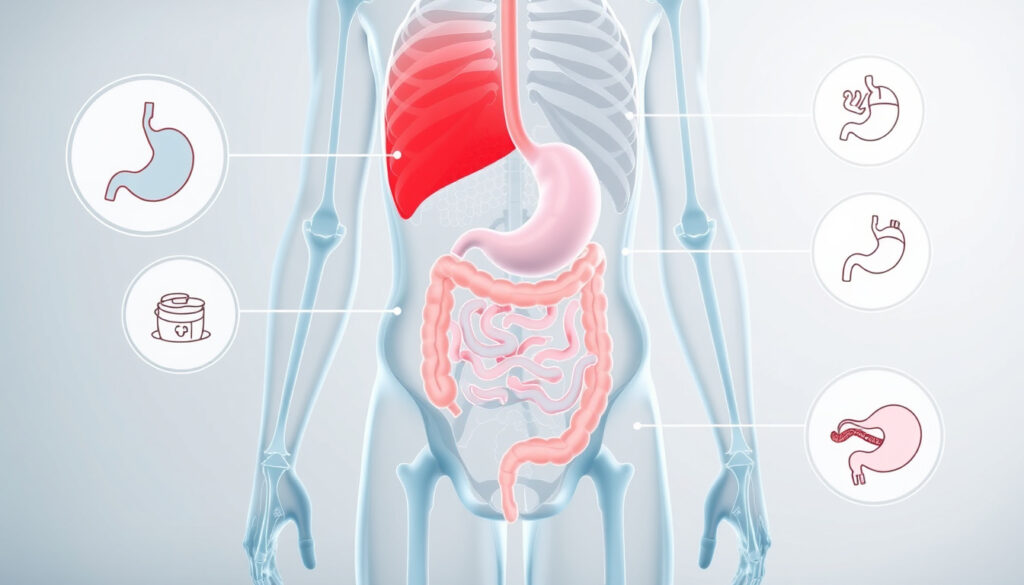
What organs are in the lower left abdomen?
Large intestine and sigmoid colon
The sigmoid colon—the S-shaped last segment of the colon—sits in the lower left quadrant. Cleveland Clinic explains that diverticula (pouches) can develop here and cause pain when inflamed.
Left kidney and ureter
The left kidney sits higher, near the flank, but pain from kidney stones or infection can radiate down to the lower left abdomen. MedPark Hospital (tertiary care hospital) describes this as a common pattern.
Reproductive organs in females
The left ovary and fallopian tube are located in the lower left pelvis. According to Mayo Clinic Community (patient forum), ovarian cysts, endometriosis, and ectopic pregnancy are among the causes of pain in this area.
Spleen and stomach location
The spleen sits in the upper left quadrant, not the lower. However, pain from an enlarged spleen can be felt in the left upper region and sometimes refer downward. The stomach is mostly upper central-left.
What this means: Lower left pain most often involves the colon, kidney, or female reproductive structures. Upper left pain may come from the spleen, pancreas, or stomach lining.
Why do I have pain on my lower left side?
Diverticulitis and diverticulosis
Diverticulitis—inflammation of small pouches in the colon—is the most frequent cause of lower left pain in adults over 40. Cleveland Clinic reports that tenderness and changes in bowel habits are typical.
Irritable bowel syndrome (IBS)
IBS-related pain often improves after a bowel movement. Providence notes that IBS is “the most common and fairly innocuous kind of left side pain.”
Kidney stones
Kidney stone pain typically comes in waves and may radiate to the groin. Digestive Health MD (gastroenterology practice) lists this as a common lower left cause.
Ovarian cysts and endometriosis (female)
Ovarian cyst pain can be sharp and is often linked to the menstrual cycle. Endometriosis causes cyclical pain that can become chronic. Mayo Clinic Community includes both as possible sources.
Muscle strain and hernia
A pulled abdominal muscle or an inguinal hernia can cause localized lower left pain. Mayo Clinic confirms these are non-serious but common.
The pattern: Lower left pain is most often colonic or renal in origin. Reproductive causes add complexity for women, and muscular issues are easily overlooked.
What organ causes pain on the left side of your stomach?
Spleen enlargement or rupture
The spleen can cause left upper quadrant pain if enlarged or ruptured. Mayo Clinic (leading medical center) notes that chronic abdominal wall pain from nerve entrapment can also mimic splenic pain.
Pancreatitis (especially chronic)
Pancreatitis pain is often felt in the upper left and may radiate to the back. NHS guidance states that pain spreading to the back or shoulder is a concerning symptom.
Stomach ulcers and gastritis
Gastritis pain is usually burning and located in the upper central or left abdomen. Medanta lists peptic ulcers as a possible cause of left-sided pain.
Left kidney infection
Left pyelonephritis (kidney infection) can cause flank and lower left pain with fever. MedPark Hospital describes the triad of fever, flank pain, and nausea.
When pancreatitis is the culprit, leaning forward often brings relief—a clue that separates it from gastritis. But over 10% of left upper pain cases are actually referred from the heart or lung, especially in older adults.
The trade-off: Upper left pain can be benign (gastritis) or dangerous (pancreatitis, splenic rupture). Radiation to the back strongly suggests pancreatic involvement.
What does pancreatitis feel like, left or right side?
Acute pancreatitis pain location and radiation
Acute pancreatitis pain usually starts in the upper middle or left upper abdomen and radiates to the back. NHS notes that pain spreading to the back or shoulder is a concerning symptom.
Chronic pancreatitis and left-sided pain
Chronic pancreatitis often causes constant dull left upper pain that worsens after eating. The pain may improve when leaning forward.
Distinguishing pancreatitis from other causes
Pancreatitis can be mistaken for gastritis or gallbladder attacks. The key difference is that leaning forward eases pancreatic pain, while gastritis pain typically persists.
When to worry about left-sided abdominal pain?
Signs of an emergency: severe pain, fever, vomiting blood
- Seek emergency care if pain is sudden and severe, accompanied by fever, or you vomit blood (NHS).
- Pain that prevents you from passing stool or gas may indicate a blockage (University Hospitals Sussex NHS Foundation Trust).
- Fever, shivering, or feeling generally unwell are listed as warning signs.
Red flags for women: ectopic pregnancy, ovarian torsion
Ectopic pregnancy can cause sharp left-sided pain and is life-threatening. Mayo Clinic Community emphasizes that ovarian torsion also presents with sudden severe pain and nausea.
Pain that wakes you up or prevents sleep
Persistent pain lasting more than 24–48 hours warrants a doctor visit. Kingston Hospital / NHS also flags involuntary weight loss or faltering growth in children as red flags.
The implication: Knowing these red flags can prevent delay in life-saving treatment.
How to tell if left side pain is serious?
Self-assessment checklist using location, type, and duration
- Locate the pain – Upper left (ribcage area) vs lower left (below belly button). This narrows the organ list.
- Rate severity – On a 1–10 scale, pain at 7+ that came on suddenly is a red flag (NHS).
- Check for accompanying symptoms – Fever, vomiting blood, back/shoulder radiation, inability to pass stool/gas mean go to ER.
- Monitor duration – If pain persists more than 24 hours without improvement, schedule a doctor visit.
- Track triggers – Does it worsen after eating? With movement? Before a period? Patterns guide diagnosis.
Tests your doctor may run: CT scan, ultrasound, blood work
If red flags are present or pain persists, your doctor may order a CT scan—the gold standard for diagnosing diverticulitis—or an ultrasound to check for ovarian cysts. Blood work can detect infection or pancreatitis.
“The most common and fairly innocuous kind of left side pain is that related to IBS.”
— Dr. Rodrigues, via Providence
“Diverticulitis is the most common cause of lower left abdominal pain in adults over 40.”
— Cleveland Clinic (academic medical center)
The implication: A single self-assessment cannot replace a clinical exam, but if you pass the red-flag filter, home care is often appropriate. The key is knowing what to watch for.
What causes lower left abdominal pain in females?
Ovarian cysts and torsion
Ovarian torsion causes sudden, severe left lower pain with nausea. Mayo Clinic Community describes this as a surgical emergency.
Endometriosis
Endometriosis pain is often cyclical and can become chronic. Providence notes that it can mimic IBS.
Ectopic pregnancy
Ectopic pregnancy must be ruled out in women of childbearing age with left pain. NHS lists it as a cause of sudden severe abdominal pain.
Pelvic inflammatory disease
PID may cause bilateral or left pain with abnormal discharge. MedPark Hospital includes infections of the reproductive tract as a source of lower left pain.
The catch: Female-specific causes overlap heavily with digestive causes, making a gynecological evaluation essential when standard GI treatments fail.
Upsides
- Most left-sided pain is from self-limiting causes like gas, IBS, or muscle strain
- Home care (rest, heat, hydration) resolves many cases within 24 hours
- Early recognition of red flags prevents complications
Downsides
- Delaying care for diverticulitis can lead to perforation or abscess
- Ectopic pregnancy or ovarian torsion can become life-threatening within hours
- Chronic undiagnosed pain can lower quality of life and lead to unnecessary anxiety
For a detailed breakdown of possible causes and red flags, see this comprehensive guide on left side stomach pain causes.
Frequently asked questions
Can left side stomach pain be gas?
Yes. Gas trapped in the colon or splenic flexure can cause sharp left-sided pain. Mayo Clinic lists gas as a common non-serious cause.
How long does left side stomach pain last with diverticulitis?
Mild uncomplicated diverticulitis typically improves within 2–4 days of antibiotics and rest. Cleveland Clinic advises that persistent pain beyond 2 days warrants re-evaluation.
What does ovarian cyst pain feel like on the left?
Ovarian cyst pain is often described as a sharp, stabbing sensation that may come and go. It can worsen during menstruation or ovulation. Mayo Clinic Community reports that rupture causes sudden intense pain.
Can a kidney stone cause left side abdominal pain?
Yes. A stone in the left ureter can cause pain that radiates from the flank to the lower abdomen and groin. Pain typically comes in waves. Digestive Health MD lists kidney stones as a cause of lower left pain.
Is left side stomach pain a sign of heart attack?
Rarely. Heart attack pain is typically central chest pressure, but it can radiate to the left upper abdomen. In older adults or diabetics, pain may be atypical. NHS advises considering cardiac causes if risk factors are present.
Should I go to the ER for left side stomach pain?
Go to the ER if the pain is sudden and severe, accompanied by fever, vomiting blood, or you are unable to pass stool/gas. Women of childbearing age should also rule out ectopic pregnancy. University Hospitals Sussex NHS Foundation Trust includes these as immediate-action symptoms.
What are the home remedies for left side stomach pain?
For mild pain, rest, a heating pad, clear fluids, and avoiding heavy meals may help. Over-the-counter antacids or simethicone can relieve gas. If pain lasts more than 24 hours, see a doctor.
Can constipation cause left side stomach pain?
Yes. Stool buildup in the descending colon and sigmoid colon can cause left-sided cramping. Providence lists constipation as a common treatable cause.
Related reading
- Paracetamol Dosage by Weight: Guide for Children & Adults – Pain management basics
- Morning After Pill Side Effects: What’s Normal and What’s Not – Relevant for women with reproductive-system concerns
Editor’s note: This article is for informational purposes only and does not substitute for professional medical advice. Always consult a healthcare provider for diagnosis and treatment.
More related posts
 How to Clean Rust from a Cast Iron Pan: 2 Effective Methods
 What Should Your Heart Rate Be – Normal Ranges by Age
 174 cm in Feet: Exact Conversion & Height Guide (5’8″ or 5’9″?)
 Better Call Saul Cast: Full List of Actors and Characters
 How to Write a Meeting Agenda: Steps, Templates & Rules
 Weather in Playa de las Americas: Current, Forecast & Guide
 Fire Country Season 4: Release Date, Cast & Episode News
 Cast of IT: Welcome to Derry: Actors, Characters & More