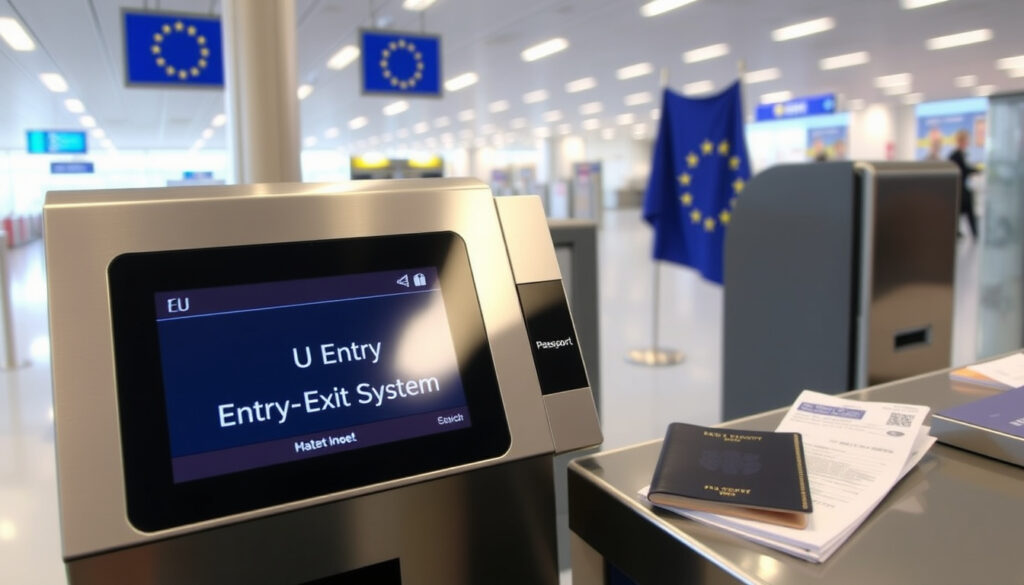
EU Entry Exit System 2025: Rules, Registration & How It Works
There’s a moment every British traveler knows: the automatic gate pauses, the light flashes orange, and you hope the passport scan works. From October 2025, that familiar routine at Schengen borders will change. A new digital system called the Entry/Exit System (EES) replaces manual passport stamps with biometric registration for all non-EU visitors. By the end of this guide, you will know exactly what to expect at the border, how to use the pre-registration app, and what rules apply to Irish citizens.
System launch date: 12 October 2025 ·
Countries using EES: 29 Schengen countries ·
Non-EU nationals affected: All short-stay travelers (up to 90 days) ·
Data collected per crossing: Biometric (photo, fingerprints) + identity ·
App available: Pre-registration via EU Travel to Europe app
Quick snapshot
- EES started on 12 October 2025 (GOV.UK official guidance)
- Applies at all Schengen external borders (EU Travel to Europe portal)
- Ireland is outside Schengen, so EES does not apply (Immigration Service Delivery Ireland)
- Exact impact on travel times at specific border points varies by country (GOV.UK)
- Full scope of technical delays at some ports or airports remains unknown (GOV.UK)
- EES launched in October 2025 after multiple delays from an initial 2023 target (GOV.UK)
- ETIAS, a linked system, is planned for late 2026 (EU Travel to Europe portal)
- UK government advises travelers to prepare for longer border processing times (GOV.UK)
- Pre-registration via the EU Travel to Europe app is available now (EU Travel to Europe portal)
UK travelers face a reset in border expectations: the old automatic e-gate routine is replaced by a deliberate biometric check. The trade-off is a digital record that lasts 3 years — but first-time processing will be slower at peak times.
What are the new entry exit rules for the EU?
Overview of the EES system
- EES is an automated digital border system that records entry and exit data for non-EU nationals traveling to the Schengen area (GOV.UK official guidance).
- It replaces manual passport stamping at border control (GOV.UK official guidance).
- The system officially launched on 12 October 2025 (GOV.UK official guidance).
What data is collected at the border?
- Biographic data: name, passport number, date of birth, nationality (EU Travel to Europe portal).
- Biometric data: four fingerprints and a facial image (GOV.UK official guidance).
- Entry and exit dates, refusal-of-entry records, and border crossing location (EU Travel to Europe portal).
Which travelers are affected?
- All non-EU nationals who are not citizens of EU countries, Iceland, Liechtenstein, Norway, or Switzerland (Immigration Service Delivery Ireland).
- Visitors staying up to 90 days in any 180-day period (GOV.UK official guidance).
- Exempt travelers include EU citizens, long-term residents, and visa holders whose status already covers their stay (Immigration Service Delivery Ireland).
Six things in the data set, one pattern: EES centralises all border data in a single digital record — no more passport stamps, no more manual counting of days. The implication: for the first time, Schengen states will share entry and exit data in real time, making overstays visible across all 29 countries.
Will Ireland use EES?
Ireland’s status as non-Schengen member
- Ireland is not part of the Schengen Area and therefore does not participate in EES (GOV.UK official guidance).
- EES applies exclusively at Schengen external borders (Immigration Service Delivery Ireland).
What the official Irish immigration website says
- Irish passport holders are EU citizens and therefore exempt from EES requirements entirely (Immigration Service Delivery Ireland).
- Irish Residence Permit holders may be exempt only if they are immediately related to an EU citizen (Immigration Service Delivery Ireland).
What this means: Irish citizens traveling from Ireland to a Schengen country will encounter EES on arrival — but as EU citizens, their passport is checked without biometric registration. The confusion many Irish travelers report is understandable: the system targets all non-EU nationals, but EU citizens are automatically excluded.
Can I pre-register for EES?
How to use the Travel to Europe mobile app
- Pre-registration is available through the EU’s “Travel to Europe” app (EU Travel to Europe portal).
- The app allows travelers to submit passport data and personal details before reaching the border.
- Biometric data (fingerprints and photo) still require an in-person visit to a border booth on the first trip.
What information you need to pre-register
- Passport information (number, expiry date, nationality).
- Personal details: full name, date of birth.
- Travel details such as planned itinerary may be requested but are not mandatory.
Is pre-registration mandatory?
- No — pre-registration is voluntary (GOV.UK official guidance).
- Travelers who skip pre-registration will have data collected at the border on arrival.
- GOV.UK advises that pre-registration may speed up border crossing processing (GOV.UK official guidance).
The catch: Pre-registration saves time at the booth, but it does not eliminate the biometric appointment. You still need to present your face and fingerprints on the first trip after launch.
If you travel through Dover, Eurotunnel Le Shuttle at Folkestone, or Eurostar at St Pancras International, EES checks happen before departure from the UK — not on arrival in France (GOV.UK official guidance). That means queues at the UK side for first-time registration.
Do I have to do EES every time I travel?
Frequency of biometric data collection
- Biometrics (fingerprints and facial image) are collected on the first entry after the system launches (GOV.UK official guidance).
- The digital EES record is valid for 3 years (GOV.UK official guidance).
- After the initial collection, only occasional biometric checks occur — typically if the record expires or if border officials request verification.
How long biometric data is stored
- Biometric data is retained for 3 years from the date of collection (GOV.UK official guidance).
- After 3 years, the traveler must re-register biometric data on the next border crossing.
- Passport data is checked every time you cross the Schengen external border (EU Travel to Europe portal).
Why this matters: For a British holidaymaker visiting twice a year, the biometric registration happens once every three years — not every trip. The passport scan and entry record, however, are captured each time. That is the distinction most travelers miss: the heavy lift is the first visit, then it is a quick digital check until the record expires.
Do I have to apply for EES?
EES vs visa vs ETIAS
- EES is not a visa application; it is an automated border system that records entry and exit data (GOV.UK official guidance).
- ETIAS (planned for late 2026) is a separate travel authorisation for visa-exempt nationals — it requires an online application before travel and costs 7 EUR (EU Travel to Europe portal).
- A visa (type C Schengen visa) is a separate permission for stays longer than 90 days or for nationals who require a visa under EU regulations.
Who needs to register in advance
- No separate application is needed for EES — data is collected at the border or via the pre-registration app (GOV.UK official guidance).
- ETIAS will require pre-travel registration online, but this is not yet mandatory as the system has not launched.
- Irish citizens are exempt from EES and ETIAS because they are EU nationals (Immigration Service Delivery Ireland).
Three systems, one pattern: EES is the border check, ETIAS is the pre-travel permission, and a Schengen visa is the extended-stay permit. The trade-off: British travelers now face a two-step future — EES from 2025, then ETIAS from 2026 — where neither requires a visa application but both add administrative steps to what was once a passport-only crossing.
Step-by-step: How to comply with EES at the border
- Before your trip
- Check whether your destination is in the Schengen area (29 countries including Norway, Iceland, Switzerland, and Liechtenstein) (Immigration Service Delivery Ireland).
- Download the EU “Travel to Europe” app from the official EU portal at travel-europe.europa.eu (EU Travel to Europe portal).
- Pre-register your passport details and personal information — this is voluntary but recommended (GOV.UK official guidance).
- Check your passport validity: ensure it is valid for at least 3 months beyond your planned departure date from the Schengen area.
- At the border — first visit after 12 October 2025
- If traveling by air or ferry (other than Dover), you will be registered on arrival in the destination country (GOV.UK official guidance).
- If traveling through Dover, Eurotunnel, or Eurostar, EES checks happen before departure from the UK (GOV.UK official guidance).
- Present your passport at a designated booth where an officer will take your fingerprints (four fingers) and a facial photograph (GOV.UK official guidance).
- Expect additional waiting time during busy periods — UK government advises being prepared to wait (GOV.UK official guidance).
- On subsequent visits (within 3 years)
- Your digital EES record will be retrieved from the system using your passport scan.
- You may need to provide a fingerprint or photo for verification, but a full re-registration is not required (GOV.UK official guidance).
- Passport data is checked at every crossing — the system records each entry and exit (EU Travel to Europe portal).
- At exit from the Schengen area
- You may be asked to provide either a fingerprint or a photo (GOV.UK official guidance).
- The system records your exit location and time to calculate your lawful stay.
- After 3 years, full biometric re-registration is required before your next entry.
The pattern: The process is most burdensome on the first visit after the system launched. Subsequent crossings are faster because the biometric template is already stored. The catch is the 3-year expiry: if you travel infrequently, you may need to re-register each time your record lapses.
The step-by-step guide shows that the first crossing is the slowest; pre-registration via the app can save time. Travelers should plan extra time at the border for biometric registration.
Timeline: key EES milestones
- — EES start date initially planned for November 2023; delayed due to technical readiness issues (GOV.UK official guidance).
- — EES goes live across all Schengen external borders (GOV.UK official guidance).
- — ETIAS launch (linked travel authorisation system for visa-exempt travelers) (EU Travel to Europe portal).
What this means: The timeline shows a phased rollout — EES first, then ETIAS a year later. For British travelers, the implication is clear: 2025 changes the border process itself, while 2026 adds a pre-travel authorisation step on top.
Clarity: confirmed facts vs unknowns
Confirmed facts
- EES began on 12 October 2025 (GOV.UK official guidance, EU Travel to Europe portal).
- EES applies at all Schengen external borders (GOV.UK official guidance).
- Ireland does not participate in EES because it is outside the Schengen Area (Immigration Service Delivery Ireland).
- Biometric data is stored for 3 years (GOV.UK official guidance).
- Pre-registration via the EU Travel to Europe app is available and voluntary (EU Travel to Europe portal).
- No fee is charged for EES registration (GOV.UK official guidance).
What’s unclear
- Exact impact on travel times at specific border points — varies by country and port/airport capacity.
- Full scope of technical delays at some ports or airports, particularly during peak summer seasons.
- Specific operational details for e-gate integration — some airports may retain manual booths longer than others.
The implication: The confirmed facts give travelers a solid procedural map. The unknowns are about real-world performance at busy crossing points — the sort of detail that only emerges in the first months of live operation.
Perspectives from officials
EES strengthens border security and reduces illegal overstays by providing authorities with accurate, real-time data on who enters and leaves the Schengen area.
British travelers should be prepared for longer border processing times, especially at busy ports and airports, and consider using the pre-registration app to speed up their first visit.
Two perspectives, one converging message: the system is operational, the process is defined, and the advice is consistent — prepare for a slower first crossing, but subsequent visits will be quicker.
Travelers flying to Dublin should check the EES rules for Ireland before departure, as the system applies to non-Schengen arrivals.
Frequently asked questions
What happens if I refuse to provide biometrics?
Border officials may refuse entry if you decline to provide fingerprints or a facial image. Under EES rules, biometric data collection is mandatory for non-EU nationals seeking to enter the Schengen area for short stays.
Can I use e-gates with EES?
Some airports may integrate EES with e-gates for faster processing, but at launch most border points use staffed booths for first-time biometric registration. Subsequent crossings may use e-gates if the system is enabled at that port.
Does EES apply to children?
Yes, children are subject to EES registration. Parents or legal guardians provide biometric data for minors at the border booth. The same 3-year validity rule applies to children’s records.
How long does the biometric check take at the border?
The initial biometric registration typically takes 1–3 minutes per person. During busy periods, queuing time can add significantly. UK government guidance advises travelers to expect additional waiting time.
Is EES the same as ETIAS?
No. EES is a digital border system that records entry and exit data. ETIAS is a separate travel authorisation for visa-exempt nationals, planned for late 2026, requiring an online application before travel at a cost of 7 EUR.
Will EES affect flights from the UK to the EU?
Yes, passengers arriving by air will experience EES checks on arrival at the destination airport. Airlines may remind passengers to have passports ready. No additional airline-led process is required beyond standard check-in.
Do Irish citizens need to register for EES?
No. Irish passport holders are EU citizens and are exempt from EES requirements entirely. Ireland is also outside the Schengen Area, so travel between Ireland and other EU member states does not trigger EES.
The FAQ above covers the most common questions; for further details, always refer to official guidance. The pattern: EES introduces a new layer of border processing, but the core requirements are straightforward.
Related reading
- Ryanair Cabin Bag Size 2025 & 2026: Rules, Dimensions & Tips — practical advice for UK and Irish travelers flying to Schengen countries.
- Things to Do in Madrid: Top Attractions & Itineraries — destination inspiration for one of the most popular Schengen area travel hubs.
Editor’s note: This guide was compiled from official EU and UK government sources published as of early 2025. Travelers should always check the latest guidance on GOV.UK and the EU Travel to Europe portal before departure, as operational details may evolve during the first months of EES implementation.
For UK travelers, the choice is clear: pre-register via the app and arrive early at the border, or risk longer queues and potential delays on the first trip. For Irish citizens, the reassurance is that your EU status keeps EES at arm’s length — but if you are traveling with a non-EU family member, their registration requirement may still affect your group’s border experience.
More related posts
 Room to Rent Cork: Best Websites, Tips & Private Landlords
 3 Bed Modular Homes Ireland Price List: Real Costs & Comparison
 Fair City Tonight Episode: Air Time, Stream & Spoilers
 Man City vs SSC Napoli Lineups – Predicted XIs, Injuries, Team News
 New Horror Movies 2025: Netflix’s Best Rated Titles
 Wedding Vow Renewal Venues: Best Spots & Planning Guide
 Houses for Sale in Kilkenny: 61 City & 217 County Listings
 Poorest Country in the World 2025: Ranking and Facts