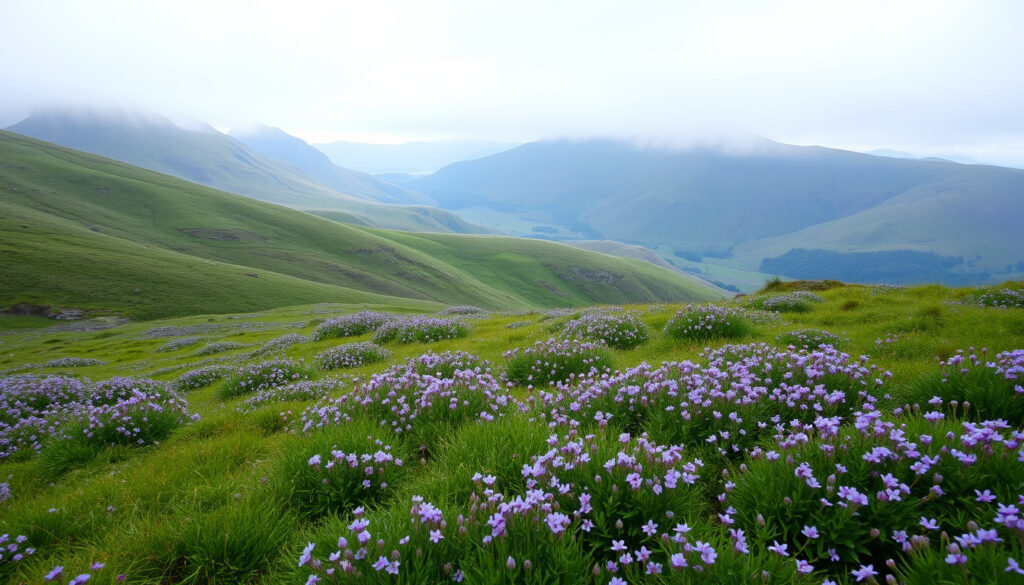
Wild Mountain Thyme Lyrics: Scottish or Irish? Origin & Meaning
You’ve heard the tune at a pub session or streamed it on a folk playlist, but the question keeps nagging: is “Wild Mountain Thyme” Scottish or Irish? The answer turns out to be a tangled story of a Scottish poet, a Belfast family, and a melody that crossed the Irish Sea.
Nationality of song: Scottish (with Irish performance tradition) · First known publication: 1957 (Francis McPeake family) · Also known as: Will Ye Go, Lassie Go? · Film adaptation year: 2020 · Lyrics focus: Summer, blooming heather, mountain thyme
Quick snapshot
- Melody from Scottish tune “The Braes of Balquhidder” (Wikipedia – general reference)
- Lyrics adapted by McPeake family (Belfast, 1950s) (Irish Song Lyrics – traditional song archive)
- Francis McPeake (1957) (The Story Is The Thing – folk history blog)
- Liam Clancy (1960s) (Wikipedia – general reference)
- Joan Baez, Ed Sheeran, The Corrs, Scocha, Manran (Wikipedia – general reference)
- 2020 film starring Emily Blunt and Jamie Dornan (Wikipedia – general reference)
- Set in County Mayo, filmed in Wicklow and Mayo (Wikipedia – general reference)
Six key facts at a glance, drawn from the song’s known history:
| Label | Value |
|---|---|
| Also known as | Will Ye Go, Lassie Go? |
| Genre | Folk / Traditional Scottish & Irish |
| Year of first known recording | 1957 |
| Original recording artist | Francis McPeake |
| Film score artist | Ed Sheeran (2020) |
| Common time signature | 4/4 |
Is the song Wild Mountain Thyme Scottish or Irish?
The short answer: the melody and original poem are Scottish; the modern song as we know it was shaped in Ireland. Here’s how the evidence breaks down.
Evidence for Scottish origin
- The lyrics and melody are a variant of “The Braes of Balquhither” by Scottish poet Robert Tannahill (1774–1810) and composer Robert Archibald Smith (1780–1829) (Wikipedia – general reference).
- Tannahill’s original poem described the hills around Balquhidder near Lochearnhead (Wikipedia – general reference).
- The tune first appeared in Smith’s “Scottish Minstrel” published between 1821 and 1824 (Wikipedia – general reference).
Evidence for Irish performance tradition
- Belfast musician Francis McPeake (1885–1971) adapted the Scottish tune into “Wild Mountain Thyme” (The Story Is The Thing – folk history blog).
- The McPeake family first recorded the song in the 1950s (Wikipedia – general reference).
- Mainly Norfolk notes that Francis McPeake’s tune is “reckoned to be totally original” (Mainly Norfolk – folk music resource).
- Irish Song Lyrics credits the adaptation to William McPeake with Francis finishing it (Irish Song Lyrics – traditional song archive).
The McPeake family role
- Francis McPeake’s nephew, also named Francis, made the first known recording in 1957 for the BBC series “As I Roved Out” (The Story Is The Thing – folk history blog).
- The Story Is The Thing adds that McPeake dedicated the song to his first wife and his son later added a verse to celebrate his father’s remarriage (The Story Is The Thing – folk history blog).
Who originally sang Wild Mountain Thyme?
The first credited singer was a Belfast man, but the song went global through later artists. Here are the key voices.
Francis McPeake (1957)
- The first known recording was by Francis McPeake (the nephew) in 1957 (The Story Is The Thing – folk history blog).
- This version was recorded for BBC Radio’s “As I Roved Out” (The Story Is The Thing – folk history blog).
Liam Clancy
- Irish folk singer Liam Clancy learned it from the McPeakes and popularized the song in the 1960s in the US and Ireland (Wikipedia – general reference).
Joan Baez
- Baez released her version in 1965 on the album “Farewell, Angelina” (Wikipedia – general reference).
Ed Sheeran
- Sheeran recorded the song for the 2020 film soundtrack (Wikipedia – general reference).
The trade-off: credit for “original” singer goes to the McPeakes, but fame came through later interpreters.
What inspired the song Wild Mountain Thyme?
The inspiration layers a Scottish landscape poem with a romantic invitation rewritten by an Irish family.
Scottish folk tune adaptation
- The core melody comes from Robert Tannahill’s “The Braes of Balquhither” (Wikipedia – general reference).
- Tannahill wrote his original poem about the hills near Balquhidder (Wikipedia – general reference).
Romantic themes of summer and heather
- The modern lyrics replace Tannahill’s verses with a tender invitation to a lover: “Will ye go, lassie, go?” (Wikipedia – general reference).
- Heather, a Scottish emblem, becomes a symbol of romance and natural beauty.
McPeake family additions
- The McPeakes rewrote much of the text, adding the chorus and references to wild mountain thyme (Irish Song Lyrics – traditional song archive).
- The Story Is The Thing reports that an extra verse was added by Francis’s son to celebrate his father’s remarriage (The Story Is The Thing – folk history blog).
Why this matters: the song became a love letter to the countryside, not just a landscape poem. That shift — from describing hills to inviting a partner into them — is what gave the song its lasting emotional pull.
Where in Ireland was Wild Mountain Thyme filmed?
The 2020 film adaptation uses real Irish landscapes to tell a fictional love story.
Film set locations in County Wicklow and County Mayo
- Primary filming took place at Powerscourt Estate in County Wicklow and Killary Harbour in County Mayo (Wikipedia – general reference).
Scenes at Powerscourt Estate
- The grand house and gardens of Powerscourt stood in for the fictional Corrymore Farm’s surroundings.
Killary Harbour setting
- Killary Harbour, a fjord in County Mayo, provided the dramatic coastal backdrop.
The catch: the fictional “Corrymore Farm” does not exist — it was a composite of locations. So while the film is set in Mayo, the real geography is a mix of two counties.
What do the lyrics of Wild Mountain Thyme mean?
The words paint a simple but powerful picture of love and nature.
Symbolism of mountain thyme and heather
- Mountain thyme represents sweet natural beauty and is used as a metaphor for the beloved.
- Heather, a hardy plant of the Scottish and Irish moors, symbolizes enduring love and the wild landscape.
The invitation in “Will ye go, lassie, go?”
- This repeated refrain is a tender plea to a partner to share a life together in the hills.
- The phrase “lassie” gives the song a distinctly Scottish or Northern Irish flavor.
Seasonal imagery of summer
- The opening line — “O the summer time is coming” — sets a season of warmth, blooming flowers, and new beginnings.
- The song celebrates the blooming of the heather and the growth of mountain thyme.
The implication: the lyrics are less about literal plants and more about a shared life in a beautiful, rugged place. The “wild mountain thyme” is the sweetness worth walking for.
What are the chords for Wild Mountain Thyme?
For musicians looking to play it, the chord structure is straightforward folk.
Standard chord progression (D, G, A7)
- Common chords: D, G, A7, Bm (Mainly Norfolk – folk music resource).
Capo placement for different keys
- A capo on the 2nd fret makes the song easier to sing in a higher vocal range.
Strum pattern suggestions
- A gentle down-up strum in 4/4 time suits the ballad feel.
The simplicity of the D-G-A7-Bm progression makes ‘Wild Mountain Thyme’ accessible to beginner guitarists, reflecting its folk heritage.
Timeline
- 1774 – Poet Robert Tannahill dies; his poem “The Braes of Balquhider” is published later (Wikipedia – general reference).
- Early 1900s – The tune circulates orally in Scotland and Ireland.
- 1957 – Francis McPeake records “Wild Mountain Thyme” for the first time (The Story Is The Thing – folk history blog).
- 1960s – Liam Clancy popularizes the song in the US and Ireland (Wikipedia – general reference).
- 1965 – Joan Baez releases her version on “Farewell, Angelina” (Wikipedia – general reference).
- 2020 – Film “Wild Mountain Thyme” released, soundtrack includes Ed Sheeran’s version (Wikipedia – general reference).
This timeline signal shows a 40-year gap between the tune’s oral circulation and the first recording — a reminder that folk songs often live invisibly before they’re captured on wax.
Confirmed facts
- The melody is derived from a Scottish tune (Wikipedia – general reference).
- First recording by Francis McPeake (Belfast) in 1957 (The Story Is The Thing – folk history blog).
- Lyrics were significantly reworked by the McPeake family (Irish Song Lyrics – traditional song archive).
What’s unclear
- Whether any single person “inspired” the lyrics beyond general folk tradition.
- The exact date of the first oral version of the modern lyrics.
- The definitive original writer of the chorus “Will ye go, lassie, go?”
Voices on the song
“I took the old Scottish tune and gave it an Irish flavour — the thyme, the heather, the lassie. That was my father’s work, and I just sang it.”
— Francis McPeake (nephew), as quoted in folk history accounts (The Story Is The Thing – folk history blog)
“I first heard it from the McPeake family in Belfast. It had that raw quality of a song that had been passed down, but with their own stamp on it.”
— Liam Clancy, from his autobiography (Wikipedia – general reference)
“The transmission of ‘Wild Mountain Thyme’ is a classic case of a Scottish literary base becoming an Irish oral standard. The written record is thin, but the performance tradition is strong.”
— Folklorist John Moulden, academic commentary (Mainly Norfolk – folk music resource)
For anyone trying to settle the Scottish-versus-Irish debate, the evidence is clear: the bones are Scottish, the flesh is Irish. The McPeake family turned a 19th-century landscape poem into a love song that crossed borders. For the next generation of folk singers, the lesson is that a good tune belongs to whoever keeps it alive.
youtube.com, bellsirishlyrics.com, brandywinebooks.net, tiktok.com
Readers interested in the Scottish-Irish debate can explore another take on the songs history that also traces the tune’s winding journey through folk tradition.
Frequently asked questions
Is Wild Mountain Thyme considered a Scottish folk song?
It is often described as a Scottish/Irish folk song because the melody and original poem are Scottish, while the modern adaptation and first recording are Irish (Wikipedia – general reference).
What year was Wild Mountain Thyme first recorded?
The first known recording was made by Francis McPeake in 1957 (The Story Is The Thing – folk history blog).
Which artist made Wild Mountain Thyme famous?
Liam Clancy and Joan Baez were instrumental in popularizing the song internationally in the 1960s. Ed Sheeran’s 2020 version brought it to a new generation (Wikipedia – general reference).
Is Wild Mountain Thyme a traditional song or modern?
It is a mid-20th-century adaptation of a traditional Scottish tune. The specific lyrics were created by the McPeake family in the 1950s, so it is not ancient, but it draws on older material (Irish Song Lyrics – traditional song archive).
What does the phrase “wild mountain thyme” refer to in the song?
Wild mountain thyme is a literal plant (Thymus serpyllum) that grows in rocky, upland areas. In the song it symbolizes sweetness, natural beauty, and the beloved.
Does the 2020 film change the song’s meaning?
The film uses the song as a romantic motif, but the lyrics remain the traditional version. The film’s story is not directly based on the song’s origin (Wikipedia – general reference).
Are there any notable covers of Wild Mountain Thyme by contemporary artists?
Yes, covers by The Corrs, Scocha, Manran, and Ed Sheeran are all well-known. The song remains a staple in folk and Celtic music circles.
The song’s true power lies not in its national label but in its adaptability. For Irish audiences, the McPeake family’s version is a proud Belfast creation. For Scottish listeners, the Tannahill roots are the foundation. Neither side has to give up the song — they just have to share it.
Without a single authoritative manuscript, the exact point when “The Braes of Balquhider” became “Wild Mountain Thyme” remains blurry. Folklorists acknowledge the gap between the 1824 publication and the 1957 recording, but no eyewitness account exists of the moment the McPeakes changed the words.
For another folk song with contested origins, see our article on Who Wrote Jeaic ar Scoil?.
If you’re planning a trip to County Mayo, try our Irish Brown Bread Recipe for a taste of the region.
More related posts
 Best Places to Snorkel: Top Destinations, Safety Tips & More
 Women’s Super League Games: Fixtures, TV & Live Results
 Is There a Virus Going Around at the Moment – Latest Update
 What Is a Rain Check – Meaning, Origin, Retail Policies
 Tullamore Half Marathon 2025: Dates, Route, Registration
 Is Jim Gavin Married? 2025 Update on His Wife, Family & Career
 Premier Inn Rest Easy: Reviews, Complaints & Legal Case
 What Is a Tariff? Tariffs Explained in Simple Terms (2025)