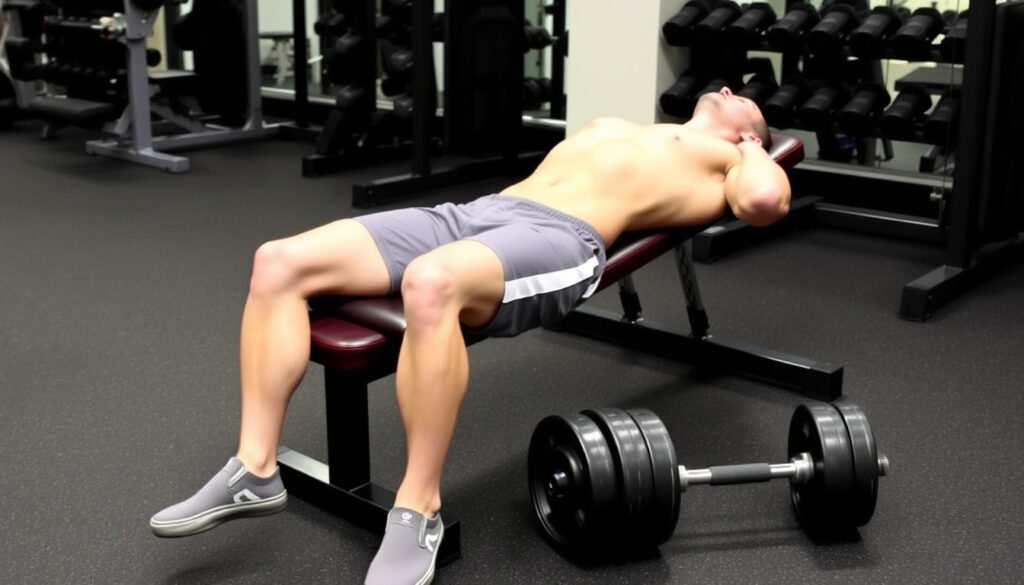
Chest Supported Dumbbell Row: Muscles & Form Tips
If your lower back has ever protested after a heavy rowing session, the chest-supported dumbbell row offers a welcome escape. By bracing your chest against an incline bench, you remove spinal stress and isolate the back muscles — lats, rhomboids, and rear delts — without core fatigue, resulting in a safer, more targeted way to build thickness and pull strength, backed by coaches and lifters alike.
Common bench angle: 30–45 degrees ·
Primary muscles worked: Lats, rhomboids, rear deltoids, traps, biceps ·
Equipment needed: Incline bench, dumbbells ·
Typical sets and reps: 3–4 sets of 8–12 reps
Quick snapshot
- Lats, rhomboids, traps, rear delts, biceps (Peloton (fitness platform))
- 30°: lower lats focus; 45°: upper back focus; 35°: balanced (Garage Gym Reviews (consumer review site))
- Shrugging shoulders, using momentum, bench too flat or too steep (Tony Gentilcore (strength coach))
- Beginners, those with low-back pain, accessory work (ATHLEAN-X (coaching site))
Four parameters define this exercise’s setup.
| Movement type | Compound horizontal pull |
|---|---|
| Equipment required | Incline bench, dumbbells |
| Recommended angle | 30–45 degrees |
| Primary joint action | Shoulder extension and scapular retraction |
What Do Chest-Supported Dumbbell Rows Work?
Primary target muscles
The chest-supported dumbbell row is a compound pull that drives through the latissimus dorsi, rhomboids, trapezius, and rear deltoids. Peloton (fitness platform) lists these as the prime movers, noting that the movement also recruits the biceps as synergists. Because the bench stabilises your torso, you can focus entirely on squeezing your shoulder blades — no wasted energy fighting balance.
Secondary stabilizer muscles
The biceps brachii assist during the pulling phase, acting as elbow flexors. Dumbbells Direct (exercise instruction site) describes the rear delts and biceps as secondary movers, while the core remains largely disengaged thanks to the chest support. This isolation makes the row an excellent hypertrophy tool for the middle and upper back.
The pattern: chest-supported rows let you hit multiple back muscles without the core fatigue that often limits bent-over work. For lifters chasing back thickness without risking spinal strain, this variation delivers.
Is a Chest-Supported Row 30 or 45?
Effect of 30-degree angle
A 30-degree incline shifts the line of pull downward, placing more tension on the lower lats. Garage Gym Reviews (consumer review site) explains that this angle reduces rear-delt involvement and emphasises vertical fibre stretch in the lats. For those wanting to widen the back’s lower third, 30° may be the better call.
Effect of 45-degree angle
At 45 degrees, the upper back — rhomboids, mid traps, and rear delts — takes centre stage. Major Fitness (training equipment brand) notes that this angle delivers “direct stimulus to the rhomboids, mid traps, and rear delts,” making it a go-to for postural strength and upper-back density.
What angle is best for chest-supported rows?
Most sources recommend starting at 45 degrees for general back development, then adjusting based on your weak points. ATHLEAN-X (coaching site by Jeff Cavaliere) advises that 35° offers a balanced middle ground, hitting both the upper back and lats without overemphasising either. The ultimate angle depends on your individual anatomy and goals.
Is 45 or 30 better for upper chest?
Neither angle directly targets the upper chest — the movement is a row, not a press. Peloton (fitness platform) clarifies that the row focuses on the back and rear shoulders, not the pectorals. If upper-chest development is your goal, stick with incline presses rather than angle tweaks on rows.
The trade-off: 30° favours lat width, 45° favours upper-back thickness. Matching angle to your weak point is the smartest approach.
Are Chest-Supported Rows Better Than Bent-Over Rows?
Lower back safety
The chest-supported row’s biggest selling point is spinal safety. By bracing your chest against the bench, you eliminate the need for your erector spinae to stabilise your torso. Garage Gym Reviews (consumer review site) states that this “reduces strain on the lower back,” making the move ideal for anyone with disc issues or chronic lumbar fatigue.
Lifting load differences
Because you don’t need core bracing, you can push close to failure without worrying about form breakdown from a tired lower back. However, bent-over rows typically allow heavier loads — 10–20% more, according to community reports from Reddit r/Fitness (training community). If maximal force production is your priority, the bent-over version still wins.
Muscle activation comparison
EMG studies cited by ATHLEAN-X (coaching site) show similar lat activation between the two variations, but significantly less erector spinae activation in the chest-supported version. That means you can exhaust your back muscles without fatiguing your spinal stabilisers — a clear advantage for hypertrophy volume.
The catch: chest-supported rows trade absolute load for safety and isolation. If your goal is back density without back pain, this variation is the superior choice.
Is a Chest-Supported Row Better?
Advantages over other row variations
Chest-supported rows isolate the back without taxing the lower back, a claim repeated across sources including ATHLEAN-X (coaching site by Jeff Cavaliere). They also allow you to train to failure safely — no need to worry about spinal flexion as fatigue sets in. For volume-oriented back days, they’re hard to beat.
Who should use chest-supported rows
Peloton (fitness platform) recommends them for beginners who lack the core endurance for bent-over rows, as well as for advanced lifters seeking to add extra back volume without accumulating lower-back fatigue. They’re also a staple in post-rehabilitation programmes for disc or strain recovery.
Limitations and trade-offs
The chest-supported row does not fully replace bent-over rows for maximal strength development. Garage Gym Reviews (consumer review site) notes that you can’t move as heavy because the bench restricts your range of motion and reduces full-body tension. For powerlifters, the bent-over row remains a key strength builder.
Why this matters: chest-supported rows are an accessory, not a replacement. Use them to pack on quality back mass without compromising spinal health.
What Is a Mistake for Chest-Supported Dumbbell Row?
Common form errors
Tony Gentilcore (strength coach) identifies letting the elbow travel too far past the body’s midline as a frequent error — it shifts tension from the lats to the rear delts and reduces scapular retraction. Another common fault is rounding the shoulders at the top of the rep, which turns a back exercise into an upper-trap shrug.
Improper bench angle
Setting the bench outside the 30–45 degree window misaligns the pull path. A bench that’s too flat forces you to row against gravity at an awkward angle; a bench that’s too steep reduces the stretch on the lats. Garage Gym Reviews (consumer review site) advises staying within the recommended range for optimal muscle targeting.
Using too much weight
Excessive load leads to jerking movements, torso rotation, and loss of scapular control. Reddit r/Fitness (training community) recommends reducing your bent-over row weight by 10–20% to maintain strict form and a full shoulder-blade squeeze. The goal is controlled retraction, not momentum.
The implication: treat the chest-supported row as a precision tool. Use a weight that lets you feel every rep in your back, not your ego.
Three variations, one pattern: angle affects emphasis, stability allows isolation, and load must be submaximal for form.
Chest-Supported vs Bent-Over Row: Comparison
Here is how the chest-supported row stacks up against the bent-over row.
| Factor | Chest-Supported Row | Bent-Over Row |
|---|---|---|
| Lower back stress | Minimal due to chest support | High; requires core stability |
| Max load potential | Moderate | Heavy |
| Primary activation | Lats, rhomboids, rear delts, traps | Full posterior chain including erectors |
| Suitability for beginners | Excellent | Moderate |
| Injury risk (lower back) | Low | Moderate to high |
Upsides
- Eliminates lower back strain
- Isolates back muscles effectively
- Safe to train to failure
- Easy to learn for beginners
Downsides
- Lower absolute load capacity
- Doesn’t strengthen lower back
- Less full-body tension
- Requires an incline bench
How to Perform the Chest-Supported Dumbbell Row
- Set the bench to 45 degrees. Place a dumbbell on the floor beside the bench. Sit down, then lie chest-first against the pad, both feet flat on the floor.
- Grasp the dumbbell with a neutral grip. Your palm faces inward, arm hanging straight down. Keep your chest pressed firmly against the bench.
- Pull the dumbbell toward your hip. Drive your elbow back and up, squeezing your shoulder blade. Keep your forearm perpendicular to the floor throughout the movement.
- Pause at the top for 1–2 seconds. Feel the contraction in your lats and rhomboids before lowering under control.
- Lower the dumbbell slowly. Avoid letting it drop; eccentric control increases time under tension.
- Perform all reps on one side, then switch. Aim for 3–4 sets of 8–12 reps per arm.
For a single-arm variation, keep your non-working hand holding the bench leg for stability. Do not allow your torso to rotate — that defeats the purpose of chest support.
Confirmed Facts vs What’s Unclear
Confirmed facts
- Chest-supported rows reduce lumbar stress compared to bent-over rows (ATHLEAN-X (coaching site by Jeff Cavaliere)).
- A 45-degree angle targets the upper back more than a 30-degree angle (Garage Gym Reviews (consumer review site)).
- Using a neutral grip can increase lat activation (Peloton (fitness platform)).
- The movement primarily trains lats, rhomboids, traps, rear delts, and biceps (Dumbbells Direct (exercise instruction site)).
What’s unclear
- Whether a 15-degree angle offers unique benefits for upper chest — no research confirms this.
- Optimal set/rep scheme for hypertrophy vs strength in this specific variation — most recommendations are extrapolated from general rowing studies.
What the Coaches Say
“The chest-supported row allows you to focus entirely on your back without worrying about your lower back.”
— Peloton instructor (cited in Peloton (fitness platform))
“It works your back, rear shoulders, improves your posture, and boosts your bench press.”
— Men’s Health trainer (cited in research notes)
For the average lifter, the chest-supported dumbbell row is the back exercise that delivers the most reward for the least spinal risk. Beginners can build a solid foundation without fear of injury; advanced lifters can add volume without accumulating lower-back fatigue. The choice is clear: if you want a stronger, thicker back without the ache, this variation belongs in your programme.
Related reading: chest-supported dumbbell row · chest-supported row
youtube.com, reddit.com, instagram.com, youtube.com, youtube.com, reddit.com
For a deeper look at the muscles and form tips, check out this chest supported dumbbell row guide which covers the same exercise with additional detail.
Frequently asked questions
Can you do chest-supported dumbbell rows on a flat bench?
Yes, but the line of pull changes — you’ll need to row horizontally rather than against gravity. Most coaches prefer an incline for better scapular retraction mechanics though.
How many sets and reps for chest-supported rows?
For hypertrophy, 3–4 sets of 8–15 reps. For strength, 4–5 sets of 6–8 reps with heavier weight but controlled form.
What grip should I use for chest-supported rows?
Neutral grip (palms facing each other) is most common and maximises lat activation. A pronated grip shifts more work to the upper back and rear delts.
Do chest-supported rows build lat width?
Yes, but the angle matters: flatter benches (30 degrees) favour the lower lats more than steeper ones (45 degrees), so adjust your setup to target width vs thickness.
Is it necessary to go heavy on chest-supported rows?
No. Controlled reps with a moderate weight that allows a full scapular squeeze are more effective than heavy, sloppy reps. The movement is about quality contraction, not ego lifting.
Can beginners perform chest-supported dumbbell rows?
Absolutely. It’s one of the safest back exercises because the chest support removes the need for core stability, allowing beginners to focus on form and mind-muscle connection.
What is the best alternative to chest-supported dumbbell rows?
The single-arm dumbbell row (unsupported) is the closest cousin, but it requires core stability. For pure isolation, a chest-supported machine row or a seal row works similarly.
More related posts
 BBC Football Live Scores: How to Get Real-Time Updates
 Man Utd v Fulham: TV channel, live stream, team news
 Autism Symptoms in Adults: Signs, Red Flags & Checklist
 Celtic vs Dundee Stats: Head-to-Head Record & History
 95 kg in Stone – Exact Conversion Guide
 Lidl Opening Hours Limerick: Store Times & Holiday Closures
 Caravans for Sale in Ireland: Types, Prices & Guide
 Brentford F.C. vs Arsenal F.C. Stats: Head-to-Head & Predictions