Top 10 Must-See Places to Visit in Ireland (2026 Guide)
There’s a reason Ireland keeps topping travel wish lists: the compact island packs an astonishing range of landscapes, history, and character, making the real challenge not finding something to see — it’s narrowing down the list. This guide ranks the top 10 places to visit in Ireland based on visitor numbers, cultural significance, and what actual travellers rave about.
Annual visitors to Ireland (2024): 6.3 million ·
Number of UNESCO World Heritage Sites in Ireland: 2 ·
Length of the Wild Atlantic Way driving route: 2,600 km ·
Tallest cliffs in Ireland: Croaghaun, 688 m
Quick snapshot
- Cliffs of Moher receive ~1.5 million visitors annually (Fáilte Ireland)
- Giant’s Causeway is a UNESCO World Heritage Site (UNESCO via travel reporting)
- Exact annual visitor numbers for smaller attractions aren’t consistently published across all counties
- Giant’s Causeway designated a UNESCO World Heritage Site in 1986 (UNESCO via A Piece of Travel)
- Off-peak travel (spring/fall) recommended to avoid June–August crowds
For quick reference, here are key facts about Ireland:
| Label | Value |
|---|---|
| Population of Ireland | 5.1 million (2024 estimate) |
| Number of counties | 32 |
| Official languages | Irish and English |
| Currency | Euro (€) in the Republic; Pound Sterling (£) in Northern Ireland |
| Peak tourism season | June to August |
What are the top tourist attractions in Ireland?
Cliffs of Moher
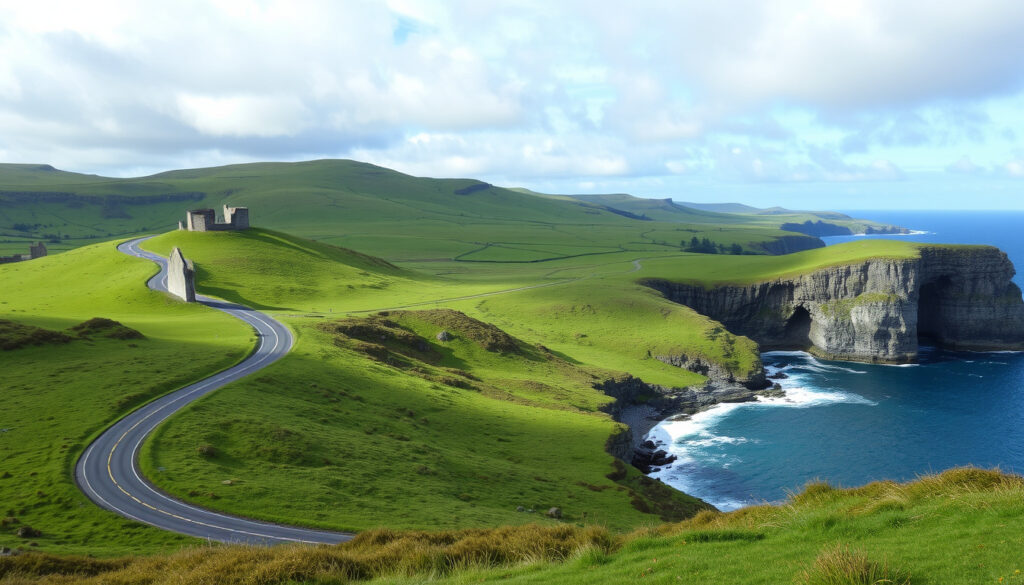
The Cliffs of Moher, rising 214 metres above the Atlantic on the County Clare coast, are Ireland’s most visited natural attraction. According to Fáilte Ireland’s official visitor survey, the Cliffs of Moher Visitor Experience drew 1,580,000 people in 2018 alone. That puts it comfortably ahead of most fee-charging attractions in the country.
- Height: up to 214 m above the Atlantic
- Annual visitors: ~1.5 million
- Location: County Clare, on the Wild Atlantic Way
- Opening hours: daily, year-round
Giant’s Causeway
On the Antrim coast of Northern Ireland, the Giant’s Causeway is a UNESCO World Heritage Site consisting of about 40,000 interlocking basalt columns. It was designated a UNESCO World Heritage Site in 1986 (UNESCO via A Piece of Travel) and is managed by the National Trust. Myths aside — local legend says the giant Finn McCool built it — the geology dates back 60 million years to volcanic activity.
The implication: the Cliffs and the Causeway alone justify a trip west and north, but they’re just the headliners of a much deeper roster.
Dublin’s Guinness Storehouse and Book of Kells
In the capital, two attractions dominate the visitor count. The Guinness Storehouse at St. James’s Gate is Ireland’s number one paid visitor attraction, drawing 1,736,156 visitors in 2018 per Fáilte Ireland. The Gravity Bar at the top offers a 360° view of Dublin. Just a 15-minute walk away, the Book of Kells at Trinity College received 1,057,642 visitors that same year — an illuminated manuscript created around 800 AD, widely considered Ireland’s greatest cultural treasure.
Dublin offers the densest concentration of top-tier attractions, but travellers who spend their entire trip here miss the landscapes that make Ireland distinctive. Two to three days in the capital, then head west.
These two Dublin attractions are must-sees, but they are just the beginning of what Ireland offers.
Which is the most beautiful part of Ireland to visit?
Wild Atlantic Way scenic coastal route
Stretching 2,600 km from County Donegal’s Inishowen Peninsula all the way to Kinsale in County Cork, the Wild Atlantic Way is one of the world’s longest defined coastal touring routes, promoted by Ireland’s official tourism body. It passes through nine counties and offers constant ocean views, sea cliffs, and sandy beaches. The route includes the Cliffs of Moher and the Skellig Ring, but its real value is the journey itself.
- Total length: 2,600 km
- Driving time: 10–14 days for a full loop
- Best for: road trips, photographers, nature lovers
- Key stops: Donegal, Sligo, Clare, Kerry
Killarney National Park and the Ring of Kerry
Killarney National Park in County Kerry contains Ireland’s only wild herd of red deer and encompasses the famous Lakes of Killarney, Ross Castle, and Muckross House. The Ring of Kerry is a 179 km circular drive through mountain passes, coastal views, and small villages. The park alone attracts over 2 million visitors annually — though exact site-level figures are not consistently published — making it one of Ireland’s most popular outdoor destinations.
Connemara and the Aran Islands
Connemara, in western County Galway, offers rugged bogs, quartzite mountains (the Twelve Bens), and traditional Irish-speaking (Gaeltacht) communities. The nearby Aran Islands — Inishmore, Inishmaan, and Inisheer — are accessible by ferry and preserve stone forts like Dún Aonghasa, perched on a 100-metre cliff. Ireland.com highlights Connemara as a region where the landscape feels ancient and unspoilt.
The pattern: the Wild Atlantic Way ties together Ireland’s most dramatic coastal scenery. Kerry and Connemara offer the best concentrated beauty along that route.
What should you not miss in Ireland?
Rock of Cashel and Blarney Castle
The Rock of Cashel in County Tipperary was the medieval seat of the Kings of Munster and a site of ecclesiastical significance since the 4th century. The surviving round tower and cathedral date largely from the 12th and 13th centuries. In County Cork, Blarney Castle draws visitors from around the world to kiss the Blarney Stone — the stone itself dates from 1446 when the castle was rebuilt, though local lore attaches much older powers of eloquence to it. Blarney Castle & Gardens received 460,000 visitors in 2018 according to Fáilte Ireland.
Titanic Belfast and the city of Derry~Londonderry
Titanic Belfast, built on the slipway where the RMS Titanic was constructed, is the world’s leading Titanic visitor experience. It opened in 2012 and has welcomed over 6 million guests. Meanwhile, the city of Derry~Londonderry in Northern Ireland is the only remaining completely walled city in Ireland. Its 17th-century city walls, among the best-preserved in Europe, stretch 1.5 km around the city centre and offer a walk through 400 years of history.
The Rock of Cashel and Derry’s walls represent Ireland’s layered history — ecclesiastical power and colonial fortification, respectively. For history-minded travellers, these two sites deliver context that natural wonders alone can’t provide.
Such historical sites give context to the natural wonders, making for a more rounded visit.
Where are the best places to visit in Ireland with family or as a couple?
Family-friendly: Dublin Zoo, Fota Wildlife Park, and the Burren
Dublin Zoo, opened in 1831, is the oldest zoo in the British Isles and received 1,230,145 visitors in 2018 — making it one of Ireland’s top paid attractions. Fota Wildlife Park in County Cork offers a more spacious, open-plan experience where kangaroos and lemurs roam freely. The Burren in County Clare provides a child-friendly outdoor adventure: a lunar-like limestone landscape dotted with wildflowers and ancient tombs.
Romantic: County Donegal, the Dingle Peninsula, Killarney
Lonely Planet named the Dingle Peninsula the best place to visit in Ireland for 2025, praising its unspoilt coastline, Irish-speaking villages, and the Slea Head Drive loop. County Donegal offers some of Ireland’s most dramatic and least-crowded beaches, like Murder Hole Beach and Silver Strand. Killarney’s combination of lakes, mountains, and luxury hotels (like the Europe Hotel) makes it a perennial favourite for couples.
The catch: families and couples often seek very different paces. Families benefit from the structured activities of Dublin Zoo and Fota, while couples tend to prefer the unhurried coastal drives of Dingle and Donegal.
What are the top 5 destinations in Ireland for a day out?
City Walls of Derry~Londonderry
Derry’s complete 17th-century city walls are among the best-preserved in Europe. Built between 1613 and 1619, they form a 1.5 km walkable circuit with seven gates and 24 original cannons. The walls never fell to an enemy, earning the city the nickname “the Maiden City.” A guided walking tour takes about 90 minutes.
Sceilg Mhichíl (Skellig Michael)
This remote rocky island off the coast of County Kerry is a UNESCO World Heritage Site, famous for its 6th-century monastic settlement and as a Star Wars filming location. Boat access is limited to calm summer days and landing capacity is strictly capped at 180 visitors per day, so booking well in advance is essential.
Copper Coast, County Waterford
The Copper Coast is a UNESCO Global Geopark stretching 25 km along the Waterford coastline. Named for the 19th-century copper mining that took place here, the area features striking cliffs, sea stacks, and coves. The Geopark visitor centre in Bunmahon explains the local geology. It’s a quieter alternative to the more famous western coastlines.
Day-trippers should pick one region and go deep. Derry offers city history, Skellig Michael delivers awe, and the Copper Coast provides peaceful geology — all within easy reach of major bases.
What we know for sure — and what remains unclear
Confirmed facts
- Cliffs of Moher receive ~1.5 million visitors each year (Fáilte Ireland)
- Giant’s Causeway is a UNESCO World Heritage Site (UNESCO designation via A Piece of Travel)
- Dublin’s Guinness Storehouse is the most visited paid attraction in Ireland with over 1.7 million annual visitors (Fáilte Ireland 2018 data)
- Rock of Cashel was the medieval seat of the Kings of Munster
- Wild Atlantic Way is one of the world’s longest defined coastal touring routes (Ireland.com)
What’s unclear
- Exact annual visitor numbers for smaller attractions are not consistently published across all counties
- Updated post-pandemic visitor data (post-2020) is not yet available for all fee-charging attractions from Fáilte Ireland
- Exact annual visitor numbers for Skellig Michael are not officially published due to strict daily caps
- Annual visitor numbers for Titanic Belfast are not broken down by year in official reports
- Composite visitor figures for the Wild Atlantic Way as a whole are not tracked by a single authority
Quotes from the experts
“The Wild Atlantic Way is the most dramatic coastal touring route in the world.”
— Discover Ireland (official tourism body), Ireland.com
“The Dingle Peninsula is the best place to visit in Ireland.”
— Lonely Planet editors, 2025 best-in-travel list
For the traveller planning a trip to Ireland, the choice is not whether to visit — it’s which Ireland to see. The Dublin-plus-Cliffs itinerary delivers the hits, but the Wild Atlantic Way, Killarney, Connemara, and Dingle reward those who venture further. The implication: if you have five days, pick one region. If you have ten, drive the coast. For the family traveller, Dublin Zoo and Fota combine easily with the Burren. For couples, Dingle and Donegal offer seclusion and scenery. Either way, Ireland’s scale works in your favour — the entire island is smaller than the state of Maine, so you can cover astonishing ground without exhausting yourself.
ricksteves.com, ireland.com, youtube.com, myirelandtour.com, youtube.com, youtube.com, youtube.com, youtube.com
Frequently asked questions
What is the best time of year to visit Ireland?
Late spring (May–June) and early autumn (September–October) offer milder weather, fewer crowds, and lower accommodation prices compared to the peak July–August period.
How many days do you need to see Ireland?
A minimum of 7–10 days is recommended. With 5 days, focus on one region (e.g., the Wild Atlantic Way). With 10–14 days, you can cover Dublin, the west coast, and parts of Northern Ireland.
Is Ireland expensive to visit?
Ireland is moderately expensive. Accommodation in Dublin and popular coastal towns can cost €150–250 per night in peak season. Dining and car rental also add up. Budget travellers can reduce costs by staying in hostels and eating in pubs.
Do I need a car to travel around Ireland?
You can rely on buses and trains between major cities, but a car offers much more flexibility for exploring rural areas like the Dingle Peninsula and Connemara. Note: rental cars in Ireland require a valid licence from your home country.
What is the currency in Ireland?
The Republic of Ireland uses the euro (€). Northern Ireland uses the pound sterling (£).
Is Ireland safe for solo travel?
Yes — Ireland is consistently ranked as one of the safest countries in the world for solo travellers. Violent crime is rare, though petty theft can occur in tourist-heavy areas like Temple Bar in Dublin.
What are the best free attractions in Ireland?
Many of Ireland’s most scenic spots are free: the Cliffs of Moher viewing areas (free coastal walks exist), the Giant’s Causeway (no fee to walk the stones), the National Gallery of Ireland (718,000 visitors in 2018 per RTÉ), and most national parks.
Related reading: County Map of Ireland: 32 Counties by Size, Safety & Scenery · UNESCO World Heritage Sites: Lists, Facts & Common Misconceptions
More related posts
 Fiat 500 for Sale in Ireland: Used Prices, Models & Tips
 88 kg in Stone – Conversion to 13 Stone 12 Pounds
 Bank of Ireland Newbridge – Hours, Location and Services
 11 Bus Route Dublin: Map, Stops & Timetable Guide
 Social Welfare Christmas Payment: Eligibility & Dates
 Steak House Near Me: Best Steakhouses in Dublin City Centre
 BBC Football Live Scores: How to Get Real-Time Updates
 Classy Short Nail Designs: Elegant Ideas for 2026