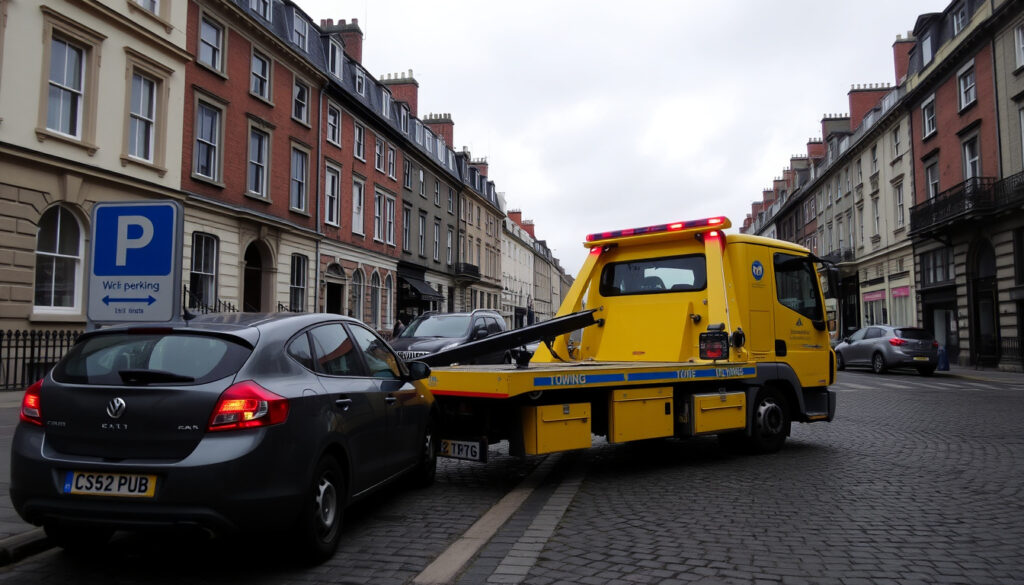
Tow Trucks in Dublin: Costs, Rules & Best Services
Few things can throw a Dublin day off course like coming back to find your car gone or a bright yellow clamp on the wheel. Whether you’re facing a breakdown on the M50 or a parking ticket that escalated to the impound lot, knowing the real cost of a tow truck and your legal rights can make the difference between a quick fix and a costly headache.
Average local tow: €80 – €150 ·
Long-distance tow: €120 – €300+ ·
Daily storage fee: €35 – €40
Quick snapshot
- A local tow in Dublin typically costs between €80 and €150 (Rescue Me (towing cost guide)).
- Long-distance recovery can run €120 to €300+ (KG Transport (Dublin towing guide)).
- Daily storage fees at impound lots average €35 to €40 (Tow It (Dublin towing guide)).
- Exact real-time pricing for every towing company without a direct quote.
- The full legality of private clamping on land without clear signage.
- Whether all companies advertising the “cheapest tow” provide true 24/7 emergency service.
- Specific insurance coverage terms for roadside assistance across all providers.
- The number of 24/7 towing companies in Dublin has grown to over 10, with operators like MBS Car Tow, CarTow, and AA Ireland competing for service (Best in Ireland (service comparison)).
- Response times are generally under 40 minutes, but can vary based on traffic and location. (Best in Ireland (service comparison))
- If your car is towed, check the Dublin City Council online register immediately. (Best in Ireland (service comparison))
- Get a fixed price quote before agreeing to any towing service to avoid hidden fees. (Best in Ireland (service comparison))
- Consider joining a roadside assistance program like AA Ireland for €11/month to cover future tows (Best in Ireland (service comparison)).
Five key figures, one pattern: towing costs in Dublin are not as uniform as most drivers assume. The table below shows the price ranges you can expect across different services.
| Service | Price range | Source |
|---|---|---|
| Local tow (under 10 km) | €80 – €150 | Rescue Me (towing cost guide) |
| Long-distance tow | €120 – €300+ | KG Transport (Dublin towing guide) |
| Daily storage fee | €35 – €40 | Tow It (Dublin towing guide) |
| AA roadside membership | €11/month | Best in Ireland (service comparison) |
| Minimum call-out fee (local) | €75 – €150 | ArticleTed (Dublin towing guide) |
The gap between the cheapest local tow and the most expensive long-distance recovery can be as wide as €220. Knowing which category your situation falls into is the first step to avoiding overspend.
How Much Is a Tow Truck in Dublin?
Standard Towing Costs in Dublin
- Local tow (under 10 km): €80 – €150 (Rescue Me (towing cost guide)).
- Short-distance tow (10–20 km): €100 – €175 (KG Transport (Dublin towing guide)).
- Long-distance tow (over 20 km): €150 – €300+ (KG Transport (Dublin towing guide)).
These bands come from actual Dublin operators. Rescue Me, a towing comparison site, reports that “typical local tow truck callouts cost €80 to €150” (Rescue Me (towing cost guide)). Fast Recovery, a Dublin-based provider, lists basic towing up to 10 km at €100 – €150 (Fast Recovery (Dublin pricing breakdown)).
Factors That Influence the Price of a Tow
- Distance: most providers include the first 5–10 km, then charge about €2 per km (Tow It (Dublin towing guide)).
- Time of day: after-hours or weekend service can add €20–€50 (ArticleTed (Dublin towing guide)).
- Vehicle type: flatbed towing for EVs or heavy vehicles is typically €100 – €200 (KG Transport (Dublin towing guide)).
- Winching or off-road recovery: €50 – €100 extra (Tow It (Dublin towing guide)).
How to Avoid Hidden Fees
- Always ask for a fixed price quote before the truck arrives.
- Confirm whether the quoted price includes the first 5 km, waiting time, and after-hours surcharges.
- Check if the company charges a “call-out fee” separate from the towing fee.
The catch: many providers advertise low base rates but add surcharges for distance, time, and equipment. A €50 quote can quickly become €150 if you don’t clarify the terms upfront.
The cheapest advertised rate often excludes the first 5–10 km. A driver who needs a 15 km tow on a Sunday evening could end up paying €180 instead of the €80 headline price.
How Do I Know if My Car Has Been Towed in Dublin?
Check the Dublin City Council Towing and Impound Register
- Dublin City Council maintains an official online register of towed and clamped vehicles. If your car is missing, check this register before reporting it stolen.
- You can search by vehicle registration number.
According to the Citizens Information service (official state advice), the council has the authority to remove vehicles that are parked illegally, abandoned, or causing an obstruction (Citizens Information (parking enforcement)).
Look for a Clamping Notice on Your Windshield
- If your car has been clamped, a notice will be left visibly on the windshield with payment instructions.
- The clamping fine set by Dublin City Council is €125 (Dublin City Council (parking enforcement)).
Contact Local Garda Stations or the Traffic Corps
- If you can’t find your car on the register, contact the nearest Garda station to check if it was moved for safety reasons or stolen.
The pattern: the fastest way to locate a towed car is the DCC online register. Calling individual companies can waste time, especially if the vehicle was moved by the council.
Is Towing Illegal in Ireland?
When Official Towing by DCC and Gardaí Is Legal
- Dublin City Council and An Garda Síochána have full legal authority to tow vehicles for parking violations, obstruction, or abandonment (Dublin City Council (parking enforcement)).
- This includes moving vehicles to a designated impound lot.
The Legal Status of Private Clamping in Ireland
- Private clamping companies in Dublin must have a license from the council under local bye-laws.
- Clamping on private land without clear signage is a grey area. Citizens Information advises that drivers should check for signs before parking and dispute charges if signage was inadequate (Citizens Information (clamping rules)).
The 110/20 Rule for Towing Trailers Explained
- The 110/20 rule governs towing speed and weight ratios in Ireland: the maximum speed when towing a trailer is 80 km/h on motorways, and the trailer weight must not exceed the towing vehicle’s unladen weight (Road Safety Authority (towing standards)).
- This applies to all trailers, including caravans and horse boxes.
The trade-off: while private clamping is legal with a license, the lack of consistent signage requirements means disputes are common. Knowing your rights under the 110/20 rule can save you from fines when towing a trailer.
Private clamping on poorly signed land is a frequent source of complaints. If you’re clamped on private property, photograph the signage and the clamp immediately — it could be the difference between a €125 fine and a successful dispute.
The implication: knowing the difference between official towing and private clamping is the first step to avoiding unnecessary costs.
What Is the Response Time for a Tow Truck in Dublin?
Average Wait Times in Dublin City vs. Suburbs
- In Dublin city centre, most operators aim for 20–30 minutes.
- In suburban areas, response times can extend to 40 minutes, depending on traffic and distance.
- QuickTow, a Dublin-based provider, states that “typical response is within 30 minutes” (QuickTow (Dublin towing cost guide)).
24/7 Emergency Towing Response
- Companies offering 24/7 emergency service, such as Express Towing and 24/7 Breakdown, advertise faster response times for breakdowns and accidents.
- Fast Recovery lists emergency towing at €150 – €250, with priority dispatch (Fast Recovery (Dublin pricing breakdown)).
What Factors Cause Delays in Response?
- Traffic congestion, especially during rush hour on the M50 and city centre roads.
- Distance from the operator’s depot to the breakdown location.
- Weather conditions and road accidents.
The implication: while 20–40 minutes is the norm, a 2–3 minute advertised response is often marketing hype. Realistic expectations start at 30 minutes for most of Dublin.
How to Choose the Best Tow Truck Company in Dublin
What to Look for in a Reliable Towing Company
- Licensing and insurance: verify the company is registered with the Irish Road Haulage Association or similar body.
- Transparent pricing: a company that offers a fixed price quote before sending a truck is less likely to add hidden fees.
- Customer reviews: check independent platforms like Google Reviews or Trustpilot.
Top companies in Dublin include 24/7 Breakdown, Express Towing, and Cartow.ie (Best in Ireland (service comparison)).
Comparing Cheap vs. Premium Services
- Cheap services often have lower base fees but may lack 24/7 availability or charge extra for weekends.
- Premium services like AA Ireland roadside assistance offer predictable costs (€11/month) but may have longer response times during peak demand.
| Company | Base fee (local) | 24/7 | Response time | Notes |
|---|---|---|---|---|
| Fast Recovery | €100 – €150 | Yes | 20–40 min | Emergency towing extra |
| Tow It | €80 – €150 | Yes | 30–40 min | Storage €35/day |
| AA Ireland | €11/month (membership) | Yes | 40–60 min | Includes breakdown cover |
| Celtic Towing | €120 – €150 | No | 20–30 min | City centre focus |
The pattern: a membership plan pays off if you’re likely to need a tow more than once a year. For a single emergency, a local operator with a fixed quote is often cheaper.
Questions to Ask Before You Call
- “What is the total cost including distance and any surcharges?”
- “Are you licensed and insured for vehicle recovery in Dublin?”
- “What is your estimated response time right now?”
A driver who calls the first number they find without asking these questions could end up paying 50% more than one who gets a fixed quote upfront. The difference is often a single phone call.
What Is the Cheapest Way to Tow a Car in Dublin?
Joining a Roadside Assistance Program
- AA Ireland’s roadside rescue membership costs €11 per month and includes towing up to a certain distance (Best in Ireland (service comparison)).
- This is often the cheapest option for drivers who anticipate needing a tow at least once a year.
Using a Tow Dolly or Trailer for Self-Towing
- Renting a tow dolly can cost €50–€80 per day, but requires a vehicle capable of towing and a valid license.
- Self-towing is only suitable for short distances and assumes the vehicle is driveable or can be winched onto the dolly.
When It’s Worth Paying for Professional Towing
- For long distances, accident recovery, or when the vehicle is not driveable, professional towing is safer and often cheaper when factoring in insurance and risk.
- Accident recovery can cost €200–€300, but includes winching and liability coverage (Fast Recovery (Dublin pricing breakdown)).
The trade-off: roadside assistance membership is the cheapest for occasional use, but for a single long-distance tow, a professional operator is often the only safe option.
Upsides
- Professional towing comes with insurance and liability coverage.
- Fixed price quotes prevent bill shock.
- 24/7 availability for emergencies.
Downsides
- Professional towing can be expensive for long distances.
- Self-towing requires a capable vehicle and proper equipment.
- Roadside assistance memberships may have limits on number of tows per year.
The catch: the cheapest option depends entirely on whether you tow once or twice a year—membership pays off with frequency.
What to Do Right Now: A Step-by-Step Guide
If Your Car Is Towed
- Check the DCC online register of towed vehicles.
- If found, note the impound lot address and contact details.
- Prepare required documents: proof of ownership (logbook), valid insurance, and a valid driving license.
- Pay the clamping fine (€125) and impound release fee (€150–€300) to reclaim your vehicle.
- Collect the vehicle from the impound lot within the specified timeframe to avoid daily storage fees (€35–€40 per day).
If Your Car Is Clamped
- Locate the clamping notice on the windshield.
- Pay the €125 fine by phone or online using the instructions on the notice.
- Wait for the clamp to be removed (usually within 2 hours).
- If you believe the clamping was unjust, photograph the signs and the clamp, then dispute with the clamping company or DCC.
“The council has a legal obligation to clearly signpost parking restrictions. If the signage is inadequate, you have grounds to challenge the fine.”
Citizens Advice representative (official consumer advice service)
“Private clamping companies must hold a valid license from Dublin City Council. If they cannot produce one upon request, the fine is not enforceable.”
Dublin City Council official statement (parking enforcement)
“The 110/20 rule is the most misunderstood regulation in Ireland. Drivers towing a trailer should never exceed 80 km/h on motorways, and the trailer must be lighter than the towing vehicle.”
National Recovery Association spokesperson (industry standards)
The pattern: the faster you act—checking the register, preparing documents, and paying fees—the less you pay in storage charges.
For Dublin drivers, the choice between a one-off tow and a membership plan is clear: if you drive in the city regularly, joining AA Ireland for €11/month is the cheapest insurance against a €150 tow. But for the occasional user, getting a fixed-price quote from a licensed local operator like Tow It or Fast Recovery is the smarter move—because a single unplanned tow can cost as much as a year of roadside cover.
Related reading: Skip Hire Near Me Ireland: Real Costs & Banned Items Guide
australianwatch.org, fastrecovery.ie, towit.ie, fastrecovery.ie, towit.ie
Frequently asked questions
Does my car insurance policy cover the cost of a tow truck in Dublin?
Most standard car insurance policies in Ireland do not include roadside assistance or towing. You typically need to add breakdown cover as an optional extra, or join a separate program like AA Ireland.
What is the maximum speed limit when towing a trailer on a motorway in Ireland?
Under the 110/20 rule, the maximum speed when towing a trailer on a motorway is 80 km/h. This applies to all single-axle trailers and caravans (Road Safety Authority (towing standards)).
Can I release my car from the Dublin City Council impound lot immediately after paying the fine?
Yes, once the fine and any impound fees are paid, you can collect the vehicle during the impound lot’s opening hours. However, after-hours releases may not be possible, and you may have to wait until the next business day.
What happens if I refuse to pay a fine issued by a private clamping company?
If you refuse to pay, the clamping company may take legal action to recover the fine. However, if the signage was inadequate or the company lacked a valid license, you may have grounds to dispute the fine. Citizens Information recommends seeking legal advice before refusing payment (Citizens Information (clamping)).
Are electric vehicles (EVs) more expensive to tow than standard cars in Dublin?
Some towing companies charge a premium for EVs because they require special handling and flatbed equipment. KG Transport lists flatbed towing for EVs at €100 – €200, which is comparable to standard vehicles (KG Transport (Dublin towing guide)).
How can I verify if a towing company in Dublin is properly licensed and insured?
Ask the company for their license number and insurance certificate. Reputable companies will provide this information upfront. You can also check with the Irish Road Haulage Association or the Dublin City Council licensing department.
More related posts
 Dunnes Ennis Opening Hours – Today, Sunday, Bank Holidays
 Full Moon November 2025: Super Beaver Moon Date & Viewing
 Close Brothers Share Price: Buy or Sell Analysis 2025
 Redken Acidic Bonding Concentrate: How It Compares to Olaplex
 Borderlands 4 Release Date: Sept 12, 2025 – Guide
 England v Ireland 6 Nations 2026: Date, Venue, Tickets & More
 Greta Thunberg Net Worth 2025: Estimates, Income & Facts
 How to Screen Record on Samsung Galaxy (2025 Guide)