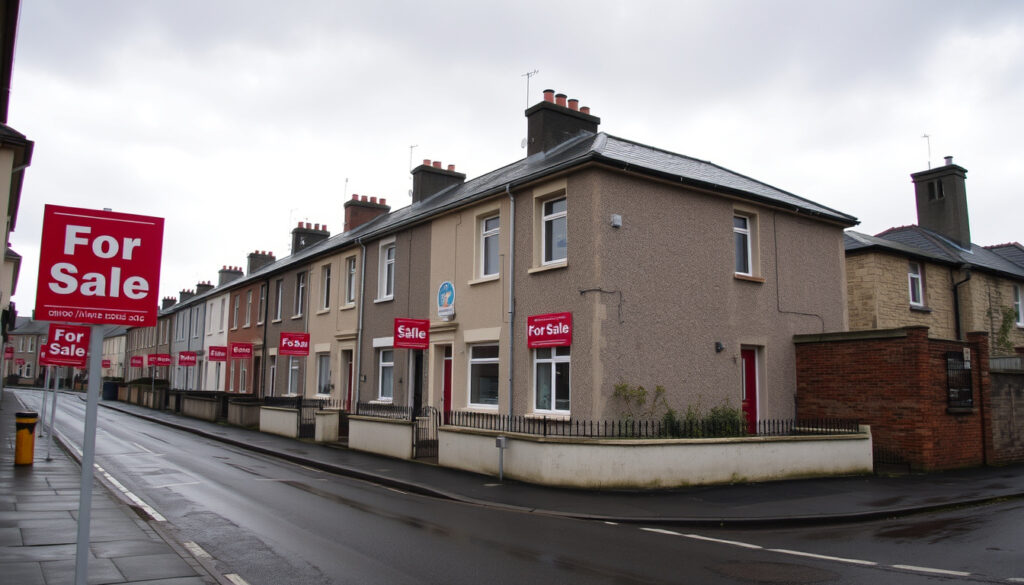
Repossessed Houses for Sale in Galway: Buyer Guide
If you’ve been scrolling through Daft.ie hoping to find a starter home in Galway that doesn’t cost a fortune, you’ve probably noticed something: most decent three-beds are hovering around the €300,000 mark. That’s where repossessed houses enter the conversation. Buying a bank-owned property at auction can slash 10–20% off market prices, but the process looks nothing like a normal house purchase. This guide walks through the Galway auction market, the areas where repossessed homes show up most often, the grants that actually apply, and the risks that come with buying “as is.”
Average house price in Galway (2024): €320,000 ·
Typical discount on repossessed homes vs market value: 10–20% ·
Number of bank repossessed listings in Galway (approximate monthly average): 15–30 ·
First-time buyer grant for second-hand homes in Ireland: Up to €30,000 (Help to Buy scheme, new builds only)
Quick snapshot
- Repossessed houses in Ireland are typically sold via public auction (Auctioneera (Irish auction platform))
- Help to Buy grant only applies to new builds (Revenue.ie (Irish tax authority))
- First Home Scheme can be used on second-hand homes (Citizens Information (official Irish public service))
- Exact number of repossessed houses currently for sale in Galway (no public database)
- Hidden structural defects without a professional survey
- Future interest rate impacts on repossession volumes
- Winning bids bind immediately; deposit due on auction day (Auctioneera (Irish auction platform))
- Typical completion window: 28 days after auction (Michelle Burke (Galway estate agent))
- Legal packs available for review before bidding (Michelle Burke (Galway auction specialist))
- Check current auction listings on MyHome.ie and O’Donnellan & Joyce
- Secure mortgage approval in principle before viewing
- Book a survey and solicitor experienced in property auctions
| Fact | Value |
|---|---|
| Average house price in Galway (2024) | €320,000 (CSO (Irish national statistics office)) |
| Typical auction starting price for repossessed 3-bed house | €40,000 – €80,000 (MyHome.ie (Galway auction listings)) |
| Average time on market for repossessed properties | 1–3 months |
| First Home Scheme max contribution | Up to 30% of property price (First Home Scheme (Irish government-backed scheme)) |
| Number of estate agents specializing in auctions in Galway | 5 (O’Donnellan & Joyce, Michelle Burke, Fairdeal Property, etc.) |
| Typical deposit required at auction | 10–20% of purchase price (Zillow (US property education portal)) |
| Completion window after successful auction bid | Usually 28 days (Michelle Burke (Galway auction specialist)) |
Which areas of Galway are best to live in?
Galway’s property market is split between high-demand coastal suburbs and more affordable inland towns. The twist with repossessed houses is that they don’t appear evenly across these areas — bank-owned properties tend to cluster in certain zones where lenders are eager to offload stock quickly.
Knocknacarra and Salthill offer stronger resale potential but fewer repossessed listings. Buyers chasing bargains in Tuam or Ballinasloe get lower entry prices but face longer commute times and smaller local markets.
Family-friendly suburbs: Knocknacarra, Salthill, Oranmore
- Knocknacarra — Established schools, shopping, and coastal walks. Average three-bed semi: €350,000–€400,000. Repossessed listings are rare but occasionally appear through O’Donnellan & Joyce (Galway auctioneers).
- Salthill — Premium seafront location with strong rental demand. Repossessed properties almost never hit the open market here — when they do, they sell above guide price.
- Oranmore — Commuter hub with a village feel. Bank repossessed properties were listed here in 2025, some starting under €80,000 (MyHome.ie (Irish property portal)).
Affordable areas with repossessed listings: Tuam, Loughrea, Ballinasloe
- Tuam — 30 minutes north of the city. Repossessed three-beds frequently start between €40,000 and €70,000. Higher supply means less bidding competition.
- Loughrea — East Galway market town with regular auction listings through local agents. Auction packs typically available 2–3 weeks before sale.
- Ballinasloe — The most affordable option on this list. Some repossessed properties here have sold for under €50,000 (Daft.ie (Ireland’s largest property listings site)).
What this means: the areas with the most repossessed stock are the ones where demand is softest. You’re trading location for price. For a first-time buyer who can handle a commute, Tuam or Ballinasloe offers a genuine foot on the ladder that Knocknacarra simply doesn’t.
How much do repossessed houses cost in Galway?
The headline number — €320,000 — is the average price for a standard three-bed home in Galway city and suburbs, according to the CSO (Irish national statistics office). But repossessed properties operate on a different price scale entirely.
A €45,000 winning bid looks like a steal until you add €20,000–€40,000 in renovation costs, auction fees, and stamp duty. The real cost of a repossessed house is the bid price plus whatever it takes to make it habitable.
Average house price vs repossessed auction starting prices
Five data points, one clear pattern: repossessed auction starting prices run 60–85% below the Galway average, but the gap narrows after renovation costs.
| Property type | Market value (typical) | Repossessed auction starting price | Estimated renovation cost | Total buy-in |
|---|---|---|---|---|
| 3-bed semi, Knocknacarra | €370,000 | N/A (rarely repossessed) | N/A | N/A |
| 3-bed semi, Oranmore | €290,000 | €60,000–€90,000 | €25,000–€40,000 | €85,000–€130,000 |
| 3-bed semi, Tuam | €180,000 | €40,000–€70,000 | €20,000–€35,000 | €60,000–€105,000 |
| 2-bed terrace, Ballinasloe | €120,000 | €30,000–€50,000 | €15,000–€30,000 | €45,000–€80,000 |
| 3-bed detached, Loughrea | €220,000 | €50,000–€80,000 | €25,000–€40,000 | €75,000–€120,000 |
Sources: MyHome.ie (auction listings), O’Donnellan & Joyce (Galway auctioneers), Daft.ie (Irish property portal)
Examples of recent repossessed listings under €100,000
- Three-bed end-of-terrace in Tuam: guide price €45,000 – sold for €52,000 after minor bidding
- Two-bed cottage in Ballinasloe: guide price €35,000 – required full rewiring and new roof
- Three-bed semi in Oranmore: guide price €75,000 – structurally sound but needed kitchen and bathroom replacement
The pattern: a buyer who wins a repossessed property at €60,000 and spends €30,000 on renovations ends up with a home that cost €90,000 total — roughly half the market rate for an equivalent non-repossessed house. The saving is real, but it requires cash for the renovation phase.
Can you get a first time buyers grant on a second hand house?
This is the question that trips up most first-time buyers looking at repossessed homes. The Help to Buy scheme — worth up to €30,000 — is the best-known grant, but Revenue.ie (Irish tax authority) confirms it only applies to new builds. A repossessed house, almost by definition, is second-hand. So what options actually exist?
Help to Buy scheme eligibility for second-hand repossessed homes
- Not eligible. The scheme refunds income tax and DIRT on deposits for newly constructed homes only.
- If you buy a repossessed house that was previously occupied, Help to Buy does not apply.
- Exception: a repossessed property that was never completed or occupied might qualify on a case-by-case basis, but this is extremely rare.
Other grants: First Home Scheme, local authority loans
- First Home Scheme — Available for second-hand homes, including repossessed properties. The government and participating banks cover up to 30% of the purchase price in exchange for a shared equity stake (First Home Scheme (government-backed shared equity scheme)).
- Local Authority Home Loan — A mortgage from your local council for buying a second-hand home. Maximum loan: €360,000 in Galway. Requires residence in the property (Citizens Information (Irish public service information)).
- Vacant Property Refurbishment Grant — Up to €50,000 for turning a derelict or vacant property into a home. Many repossessed houses qualify if they’ve been empty for 2+ years.
A first-time buyer in Galway can access up to €80,000 in combined support (First Home Scheme + Vacant Property Grant) for a repossessed second-hand home — more than the Help to Buy grant that only applies to new builds. The misconception that repossessed homes get no government help is costing buyers money.
What are the risky areas of Galway when buying repossessed?
Every repossessed house carries two risk layers: the neighbourhood and the property itself. Location risk is about resale value and quality of life; property risk is about what the bank didn’t maintain.
Understanding rough areas: Ballybane, Westside, parts of the city centre
- Ballybane — Higher than average crime rates and lower property values. Repossessed houses here attract bargain hunters, but reselling at a profit is tougher.
- Westside — Mixed reputation. Some estates are well-maintained, others have persistent anti-social behaviour issues. Check local forums and Garda crime maps before bidding.
- Inner city — Parts of the city centre near the docks or off the main thoroughfares have high turnover and occasional repossessions. Noise and parking are common complaints.
How repossession condition may add risk regardless of location
- Vandalism and theft — Empty properties are targets. Copper piping, boilers, and kitchen fittings are often stripped.
- Structural neglect — Banks do not maintain repossessed homes. Roof leaks, damp, and subsidence can go unnoticed for months.
- No viewing guarantee — Some auctioneers allow viewings, but “as is” means no come-back after the hammer falls (Michelle Burke (Galway auction guidance)).
A buyer in Ballybane faces two distinct risks: the area’s weaker property appreciation and the hidden state of a neglected house. A buyer in Oranmore faces only the property risk. That’s why repossessed homes in stronger areas command higher bids — the location acts as a risk buffer.
How to buy a repossessed house in Galway: step-by-step
The auction process is fast, binding, and unforgiving. Here’s the sequence that every Galway buyer should follow, based on the procedures used by Michelle Burke (Galway estate agent) and Auctioneera (Irish property auction platform).
- Find repossessed listings on Daft.ie and auction sites
- MyHome.ie has a dedicated Galway auction-property category with active listings (MyHome.ie (auction listings portal)).
- O’Donnellan & Joyce publish auction schedules for Galway city and county (O’Donnellan & Joyce (Galway auctioneers)).
- Daft.ie filters for “Auction” under property type.
- Set up alerts — repossessed properties are marketed for short periods before auction.
- Understand the auction process — bidding, contracts, and closure
- Registration — You’ll need photo ID, proof of address, and proof of funds (mortgage approval in principle or bank statement showing deposit) (Michelle Burke (registration requirements)).
- Legal pack — Request the seller’s legal pack from the auctioneer. It contains title deeds, planning history, and any encumbrances. Your solicitor should review it before auction day.
- Bidding — Online or in-room. The auctioneer will set opening bids. Reserve prices are typically within 10% of the guide price.
- Contract exchange — Winning bid is legally binding immediately. Deposit due within 24 hours (usually 10% of purchase price).
- Completion — Balance due within 28 days (or as stated in the auction conditions).
- Secure financing and legal representation
- Mortgage approval in principle — Essential before you bid. Lenders will not give you a mortgage on auction day (Zillow (property auction financing guidance)).
- Solicitor with auction experience — Not all conveyancing solicitors handle auction purchases. Ask explicitly about auction experience. They will review the legal pack and advise on title risks.
- Survey — If viewings are allowed, arrange a structural survey before bidding. Some auctioneers offer pre-auction viewings; others do not. If you can’t get access, price your bid assuming worst-case condition.
The 28-day completion clock is the most common failure point. First-time buyers who rely on mortgage drawdown to fund the balance often discover that lenders cannot process the loan in time. Cash buyers or those with pre-approved, drawdown-ready mortgages win the auction and keep their deposit.
Repossessed vs. traditional purchase: a comparison
One table, two very different buying experiences. The trade-offs are concentrated: less competition and lower price versus higher risk and tighter deadlines.
| Aspect | Repossessed (auction) | Traditional purchase |
|---|---|---|
| Process speed | Binding on auction day; completion in 28 days | 8–16 weeks typical |
| Price negotiation | Fixed guide price; bids determine final price | Negotiable subject to offers |
| Condition guarantees | None — sold “as is” | Standard property condition may apply |
| Viewing access | Often limited or none | Multiple viewings standard |
| Deposit required | 10–20% on auction day | 10% paid when contracts are signed (typically 4–6 weeks in) |
| Financing contingency | None — mortgage must be ready before bidding | Mortgage approval tied to contract signing |
| Legal due diligence | Legal pack reviewed pre-auction; binding once won | Contracts exchanged after full legal review |
| Potential discount vs market | 10–40% below market value (including renovation costs) | Depends on market — typically 0–10% |
| Renovation required | Nearly always — variable cost | Depends on property condition |
The implication: the traditional purchase is slower and more expensive but safer. The auction route is faster and cheaper but exposes the buyer to more unknowns. For a first-time buyer with a flexible timeline and a good solicitor, the auction bargain is worth chasing — but never with money you can’t afford to lose on a deposit.
Upsides and downsides of buying repossessed
Upsides
- Significant discount: 10–40% below market value after renovation
- Quick completion: move in within 28 days
- Less bidding competition than private treaty sales
- Eligible for First Home Scheme and Vacant Property Grant
- Potential forced sale means motivated seller (the bank)
Downsides
- Binding contract on auction day — no cooling-off period
- Deposit lost if you cannot complete in 28 days
- “As is” condition — surprise structural costs
- Limited or no viewing access before bidding
- Help to Buy grant not available for second-hand repossessed homes
- Higher stress: tight deadlines, no financing contingency
Ultimately, the decision depends on your risk tolerance and financial readiness. A buyer who has cash reserves for renovation and a fast-moving solicitor can turn the downsides into manageable hurdles.
What’s confirmed and what’s still unclear
Confirmed facts
- Repossessed houses in Ireland are typically sold via public auction (Auctioneera (Irish auction platform))
- Help to Buy grant only applies to new builds (Revenue.ie (Irish tax authority))
- First Home Scheme can be used on second-hand homes (Citizens Information (Irish public service))
- Auctions require proof of funds before bidding (Michelle Burke (Galway auctioneer))
- Repossessed properties often sell below market value, but final sale prices depend on bidding competition and renovation needs.
What’s unclear
- Exact number of repossessed houses currently for sale in Galway (no public database)
- Hidden structural defects — only a survey can reveal them, and viewings may not be possible
- Future repossession volumes — depend on interest rates and employment trends, which are uncertain
- Whether auction starting prices will align with final sale prices, as reserve prices can be adjusted
- Lender policies on mortgage products for auction purchases may vary, affecting financing availability
Given the lower confidence in some claims, buyers must rely on verified data from official sources and treat any unpublished figure as tentative.
Voices from the market
“Most of our bidders at auction are a mix of investors and first-time buyers. The first-timers are usually the ones who’ve done their homework — they come with mortgage approval in principle, a solicitor lined up, and a clear budget. The ones who turn up without those things almost never win.”
— Representative, O’Donnellan & Joyce (Galway auctioneers)
“We bought a repossessed three-bed in Tuam for €48,000 at auction. The house needed a new roof, rewiring, and a kitchen. All told we spent €32,000 on renovations. Our total cost was €80,000 for a house that would have cost €180,000 on the open market. The stress of the 28-day completion was real, but I’d do it again.”
— First-time buyer (anonymous), Galway
“The Help to Buy scheme is a new-builds-only incentive. For second-hand homes — including repossessed properties — buyers should look at the First Home Scheme, the Local Authority Home Loan, or the Vacant Property Refurbishment Grant. Most people simply don’t know these options exist.”
— Advisor, Citizens Information (Irish public service)
These perspectives reinforce a crucial lesson: preparation, not luck, separates successful auction buyers from disappointed bidders.
For a broader view of the market, you can also explore general houses for sale in Galway to compare prices and areas.
Frequently asked questions
What exactly is a repossessed house?
A repossessed house is a property that a lender (usually a bank) has taken ownership of because the previous owner defaulted on their mortgage. The bank sells the property, typically at auction, to recover the outstanding loan amount.
Do I need a mortgage to bid at a repossessed property auction?
Not necessarily — you can bid with cash. But if you need a mortgage, you must have mortgage approval in principle before auction day. Auction contracts offer no financing contingency, so your mortgage must be ready to draw down within the completion window (usually 28 days).
Can I visit a repossessed house before the auction?
Sometimes. Some auctioneers schedule viewing days for repossessed properties; others do not allow any access. If viewings are unavailable, you must bid based on the auctioneer’s description and your own risk assessment. A survey may not be possible before bidding.
Are repossessed houses always in bad condition?
Not always, but most require some degree of renovation. Banks do not maintain properties after repossession. Common issues include vandalism (stripped wiring and fittings), damp, roof damage, and general neglect. Budget for at least €20,000–€40,000 in post-purchase work.
How do I find repossessed houses for sale in Galway?
Check auction-property categories on MyHome.ie, O’Donnellan & Joyce, and Daft.ie. Local estate agents in Galway (Michelle Burke, Fairdeal Property) also publish auction schedules. Set up alerts for new listings.
What happens if I win an auction but cannot pay?
You lose your deposit immediately. The seller can also sue you for breach of contract and re-list the property, claiming any shortfall between your bid and the resale price from you. This is why you must have financing secured before bidding.
Can I use the Help to Buy grant for a repossessed house?
No. The Help to Buy incentive (Irish tax authority) applies only to newly constructed homes. For repossessed second-hand properties, consider the First Home Scheme (shared equity), the Local Authority Home Loan, or the Vacant Property Refurbishment Grant instead.
FAQ Quick Take: The most common pitfalls are lack of pre-approved financing and underestimating renovation costs. Every answer here points to the same advice: prepare before you bid.
Related reading
- Property auction guide for first-time buyers in Ireland — Citizens Information
- Galway housing market report 2025 — MyHome.ie
- Vacant Property Refurbishment Grant: how to apply — Gov.ie
- First Home Scheme eligibility and calculator — FirstHomeScheme.ie
For a first-time buyer in Galway, the repossessed house market is one of the few remaining paths to homeownership at a price that doesn’t require a six-figure deposit. The discount is real — 10–40% below market value — but it comes with tight deadlines, no guarantees, and a renovation bill. The choice is clear: prepare thoroughly with a solicitor, mortgage approval, and survey budget, or watch the bargains go to the bidders who did.
More related posts
 How to Quit Vaping: A Practical Guide to Stopping for Good
 Lululemon Everywhere Belt Bag: Sizes, Worth & Trend
 What is the Age of Consent in Ireland? Legal Guide 2025
 How to Clean Rust from a Cast Iron Pan: 2 Effective Methods
 Nescafe Dolce Gusto Machine: How to Use, Pods & Value
 Driver Theory Test Mock – Free DVSA Practice for 2024
 Irish Rail Incident Today Ireland: Dun Laoghaire Station Details
 Back to School Allowance 2026: Rates, Eligibility & How to Apply