How to Quit Vaping: A Practical Guide to Stopping for Good
Anyone who’s tried to quit vaping more than once already knows the feeling: the craving hits, the anxiety spikes, and the vape somehow finds its way back into your hand. The good news is that nicotine withdrawal is temporary—and there’s a growing body of evidence-backed strategies that make quitting genuinely achievable.
U.S. high school students who vape (2023): 10% (CDC) ·
Nicotine withdrawal peak: Days 3–7 ·
Lung healing start after quitting: Within 2 weeks ·
Successful quit attempts with support plan: Up to 55% (HSE Ireland)
Quick snapshot
- Nicotine withdrawal is temporary and peaks within a week (PubMed Central (clinical literature))
- Lungs heal within weeks of quitting (American Lung Association (respiratory health authority))
- NRT doubles quit success (CDC (U.S. public health agency))
- Setting a quit date improves outcomes (HSE (Irish health service))
- Whether 2 puffs of vape a day significantly harms health (limited evidence)
- Exact timeline for full lung recovery after years of vaping
- Effectiveness of cold turkey vs. NRT in vaping specifically
- Cravings start within 4–24 hours of last vape (LosangelesInsight.com (vaping cessation resource))
- Withdrawal peaks at days 3–7 (Gale (health information platform))
- Physical symptoms ease in 1–2 weeks (Gale (health information platform))
- Lung function improves within 2 weeks (American Lung Association (respiratory health authority))
- Cilia repair begins after 1 month (American Lung Association (respiratory health authority))
- After 1 year, heart disease risk drops by half (CDC (U.S. public health agency))
Four key facts, one pattern: the timeline for vaping recovery is measurable, predictable, and surprisingly fast once you stop.
| Metric | Detail |
|---|---|
| Time to peak withdrawal | 3 to 7 days after quitting (Gale (health information platform)) |
| Effectiveness of NRT | Doubles chance of quitting (CDC (U.S. public health agency)) |
| Lung healing begins | Within 2 weeks of stopping (American Lung Association (respiratory health authority)) |
| Heavy users: lung recovery | Significant improvement in 1-3 months (American Lung Association (respiratory health authority)) |
What is the best way of quitting vaping?
- Set a quit date and reduce nicotine gradually
- Use nicotine replacement therapy (NRT)
- Lean on support apps like quitSTART
- Find distractions and coping strategies
Set a quit date and reduce nicotine gradually
Health authorities around the world agree on one starting point: pick a date and build a plan around it. The HSE (Irish health service) recommends identifying triggers and deciding how you’ll handle them before quitting day. The Government of Canada (federal health regulator) suggests delaying your first vape as long as possible and telling a friend about your plan.
Two broad approaches work for nicotine reduction:
- Quit all at once with NRT support – stop vaping entirely on your quit date and use nicotine replacement therapy to manage cravings.
- Taper nicotine strength and frequency – gradually reduce the nicotine level of your vape liquid over weeks before a final quit date, as described by Quitty (vaping cessation app).
The Australian Department of Health and Aged Care says that combining a quit date with a concrete craving plan—using the “4 Ds” (Delay, Deep breathe, Distract yourself, Drink water)—can make the difference between a failed attempt and a successful one.
Use nicotine replacement therapy (NRT)
Nicotine replacement therapy is the most effective pharmaceutical aid for quitting nicotine. The CDC (U.S. public health agency) notes that NRT doubles your chance of quitting successfully. A common approach is combining a long-acting nicotine patch (put on a fresh patch each morning, wear it for 24 hours) with a fast-acting product like gum or lozenges for breakthrough cravings, as advised by Nicozon (nicotine replacement resource).
Clinical guidance from PubMed Central (peer-reviewed medical research) recommends a minimum NRT treatment duration of 8 to 12 weeks. For pregnant or breastfeeding people, the same guidance suggests behavioral therapies first, with NRT considered second line.
Lean on support apps like quitSTART
Free digital tools can provide the structure that willpower alone often lacks. The HSE (Irish health service) points to SmokefreeTXT and the quitSTART app as evidence-based resources. The Australian Department of Health and Aged Care recommends the My QuitBuddy app and the Pave app for tracking progress and connecting with community support.
Find distractions and coping strategies
Cravings typically last 3 to 5 minutes, according to Quitty (vaping cessation app). The trick is having a pre-planned response for those minutes. The HSE (Irish health service) recommends: distract yourself, delay until the craving passes, do 20 deep breaths, and drink a glass of water in small sips.
Other practical replacements include chewing gum or sunflower seeds to keep your mouth busy, taking a short walk, or calling a friend you’ve told about your quit plan.
The implication: there’s no single “best” method—what works is a structured plan that combines a quit date, medical support if needed, and ready-to-use coping strategies for when cravings hit.
How long does vape withdrawal last?
Physical withdrawal timeline: 3–14 days
Withdrawal symptoms can begin within 4 to 24 hours after your last vape, according to LosangelesInsight.com (vaping cessation resource). They typically peak around days 2 to 3 or days 3 to 7, as described by Gale (health information platform). Clinical research published in PubMed Central (peer-reviewed medical research) confirms this pattern: anxiety and panic-like symptoms begin within hours to day 1, peak in the first week, and gradually resolve over 2 to 4 weeks.
Most physical withdrawal symptoms ease within 1 to 2 weeks, and by about 3 to 4 weeks, the worst is largely over—though situational cravings can persist longer.
Psychological cravings can persist for weeks
While the physical symptoms fade, the psychological habit of vaping—reaching for your device when stressed, bored, or after a meal—can take longer to break. The HSE (Irish health service) notes that identifying your triggers beforehand is crucial, because the mental cravings are what cause most relapses.
Symptoms include irritability, anxiety, and difficulty concentrating
Common withdrawal symptoms reported by quitters include irritability, anxiety, restlessness, difficulty concentrating, increased appetite, and strong cravings for nicotine. These are temporary and a sign that your body is adjusting to functioning without nicotine.
For anyone quitting, the hardest days are the first week. Knowing that the peak is predictable—and passes—can make the difference between giving in and powering through.
The pattern: withdrawal is a short-term price for a long-term gain. Most physical symptoms resolve within a month, and exercise, distraction, and support systems all reduce craving intensity.
What can I replace vaping with?
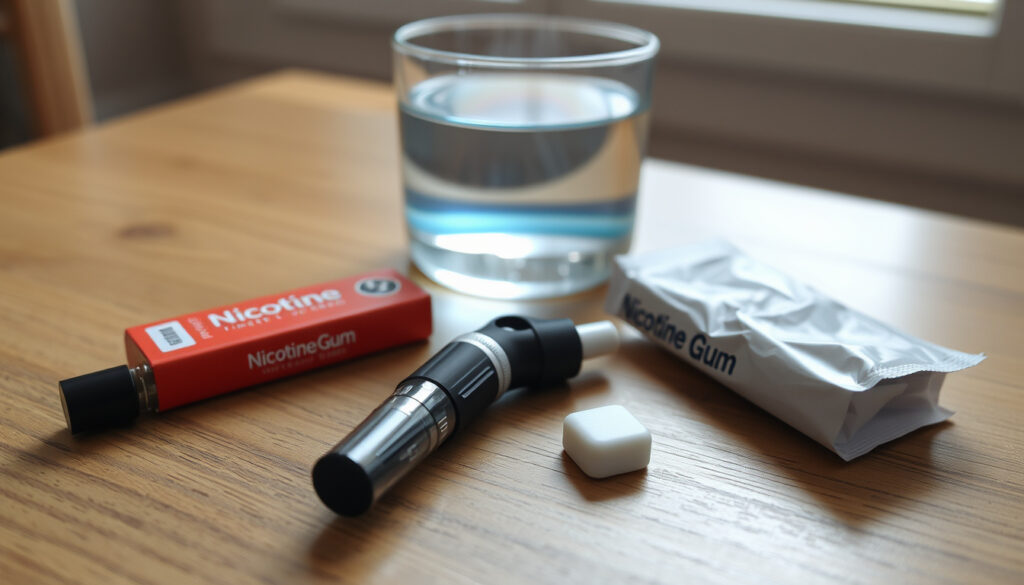
Nicotine gum, lozenges, or patches
NRT products are the most effective replacement for the nicotine your body craves. The FDA (U.S. drug regulator) has approved nicotine gum, lozenges, and patches as safe and effective aids for quitting. The CDC (U.S. public health agency) advises applying a fresh patch each morning for consistent nicotine delivery throughout the day.
Chewing gum or sunflower seeds
For the oral fixation aspect of vaping—the hand-to-mouth motion that’s become a habit—simple replacements like sugar-free gum or sunflower seeds can fill the gap. The Australian Department of Health and Aged Care includes “distract yourself with something else in your mouth” as part of their official craving strategy.
Deep breathing exercises (20 breaths + water)
The HSE (Irish health service) recommends a specific breathing technique: take 20 slow, deep breaths when a craving hits, then drink a glass of water in small sips. This combination interrupts the craving cycle and gives your brain time to reset—most cravings last only 3 to 5 minutes.
Physical activity like short walks
Exercise is one of the most effective natural craving-busters. A short walk, a few jumping jacks, or even stretching can reduce the intensity of nicotine cravings by releasing dopamine naturally. The Australian Department of Health and Aged Care encourages physical activity as part of a healthy quit plan.
Why this matters: replacement isn’t about finding a perfect substitute—it’s about having a list of options ready so that when a craving arrives, you don’t reach for the vape by default.
Will my lungs heal if I stop vaping?
Short-term healing: cilia regrowth in weeks
Yes, your lungs begin healing almost immediately after you quit. The American Lung Association (respiratory health authority) reports that lung function starts improving within 2 weeks of stopping. Within 1 month, the tiny hair-like structures in your lungs called cilia begin to repair themselves, helping to clear mucus and reduce coughing.
Long-term: reduced inflammation and lung function improvement
Over 1 to 9 months, cilia regrow more fully, and symptoms like shortness of breath and coughing continue to decrease. After 1 year, the CDC (U.S. public health agency) notes that the risk of heart disease drops to half that of a current smoker. For heavy users, significant lung improvement is seen in 1 to 3 months.
Full recovery depends on duration and intensity of use
How completely your lungs recover depends on how long you vaped and how heavily. Research suggests that quitting before age 40 can restore nearly normal lung function. However, the exact timeline for full recovery after years of vaping remains unclear, as the long-term effects of e-cigarettes are still being studied.
The trade-off: lungs heal quickly in the short term, but long-term recovery is dose-dependent. Every day without vaping is progress, regardless of past use.
How to quit vaping cold turkey?
Stop all nicotine use immediately and handle withdrawal
Cold turkey means quitting all at once, without tapering or NRT. It works for some people, but success rates are lower than with NRT-supported attempts. Withdrawal symptoms may be more intense, as the body gets no gradual reduction in nicotine. The HSE (Irish health service) notes that having a support system significantly increases success even with this approach.
Use behavioral strategies like smashing the device
Some quitters find a symbolic break helps—physically destroying or discarding their vaping device to remove temptation. This aligns with the Australian Department of Health and Aged Care advice to remove all vaping products from your home and environment as part of quit-day preparation.
Monitor cravings with a tracking app
Apps like quitSTART or My QuitBuddy allow you to log cravings, track how much money you’ve saved, and see health milestones as they happen. This gamification element can be especially helpful for cold-turkey quitters, who face the strongest immediate withdrawal.
The catch: cold turkey works best for lighter users or those with high motivation. For anyone who’s tried cold turkey and relapsed, NRT or gradual reduction is a more evidence-backed next step.
Timeline: What happens after you quit vaping
Carbon monoxide level drops, oxygen flow improves (CDC (U.S. public health agency)).
Blood circulation and lung function improve (American Lung Association (respiratory health authority)).
Cilia regrow, cough and shortness of breath decrease (American Lung Association (respiratory health authority)).
Risk of heart disease drops by half compared to a smoker (CDC (U.S. public health agency)).
The timeline confirms that recovery is measurable and starts within hours.
What the evidence says about quitting vaping
Confirmed facts
- Nicotine withdrawal is temporary and peaks within a week (PubMed Central (clinical research))
- Lungs heal within weeks of quitting (American Lung Association (respiratory health authority))
- NRT increases quit success (CDC (U.S. public health agency))
- Setting a quit date improves outcomes (HSE (Irish health service))
What’s unclear
- Whether 2 puffs of vape a day significantly harms health (limited evidence)
- Exact timeline for full lung recovery after years of vaping
- Effectiveness of cold turkey vs. NRT in vaping specifically
The evidence base is strong but has gaps; the unclear areas highlight where further research is needed.
Expert perspectives on quitting
“The first step in quitting vaping is wanting to quit. Distract yourself, delay until the craving passes, do 20 deep breaths and drink a glass of water in small sips.”
— Oncologist from HSE Ireland (national health service)
“There are tools available to help you quit. Download the quitSTART app or try SmokefreeTXT.”
Both sources emphasize that quitting is possible with the right strategies and support.
Summary
Quitting vaping isn’t a test of willpower—it’s a measurable process with predictable peaks and clear strategies that work. The evidence from health authorities across the U.S., Ireland, Canada, and Australia converges on the same core: set a date, lean on NRT or structured support, and know that the worst withdrawal passes within a week. For anyone vaping today, the choice is clear: start your quit plan now, or let the habit make the choice for you.
Frequently asked questions
Can vaping cause permanent lung damage?
Research is ongoing, but evidence suggests that while vaping is less harmful than smoking cigarettes, it is not risk-free. Some cases of lung injury (EVALI) have been linked to vaping, particularly with THC-containing products. Quitting vaping significantly reduces the risk of long-term damage.
Is it safe to vape zero-nicotine liquid while quitting?
Zero-nicotine vape liquid removes the chemical addiction component but still exposes your lungs to aerosolized chemicals. Health authorities generally recommend transitioning away from all vaping rather than switching to nicotine-free vaping, as the behavioral habit can sustain the addiction cycle.
What are the most common vaping withdrawal symptoms?
Common symptoms include irritability, anxiety, difficulty concentrating, restlessness, increased appetite, and strong cravings for nicotine. These symptoms peak in the first week and typically resolve within 2–4 weeks, according to clinical research published in PubMed Central (peer-reviewed medical research).
Does exercise help with nicotine cravings?
Yes. Physical activity releases dopamine naturally, which can reduce the intensity of nicotine cravings. The Australian Department of Health and Aged Care recommends short walks or activity as part of a healthy quit plan.
How soon can I see health improvements after quitting vaping?
Within 24 hours, carbon monoxide levels drop. Within 2 weeks, lung function begins to improve. Within 1 month, cilia start repairing. Within 1 year, heart disease risk drops by half, according to the CDC (U.S. public health agency).
Should I tell friends and family I am quitting?
Yes. The Australian Department of Health and Aged Care recommends confiding in a trusted person for support and accountability. Knowing that someone is checking in on your progress can increase your chances of success.
What should I do if I relapse and vape again?
Relapse is common and not a failure. The HSE (Irish health service) advises reviewing what triggered the relapse, adjusting your plan, and trying again. Each attempt builds experience that increases the likelihood of long-term success.
These FAQs address the most common concerns about quitting vaping.
Related reading
More related posts
 Best Cheap Gaming Laptops 2026: Budget Picks & Buying Tips
 Things to Do in Madrid: Top Attractions & Itineraries
 West Ham vs Bournemouth: 0-0 Result, Highlights, Lineups
 The West Cork Hotel: Complete Guide to Skibbereen Accommodation
 The New York Post: News, Bias, Today’s Cover & More
 Driver Theory Test Mock – Free DVSA Practice for 2024
 Best Duck à l’Orange Near Me: Top Spots & Pairings
 Farm Machinery for Sale in Ireland – 2025 Buying Guide